






Comprehensive Fertility Treatments | Gynaecology Procedures | Menopause Management | Pregnancy Care | Maternity & Birthing
Low AMH Success Story | Achieving Motherhood with Gunjan IVF World
For countless couples around the world, the journey to parenthood begins with hope—but for many women, that hope is shadowed by a diagnosis that sounds final: low Anti-Mullerian Hormone (AMH). This hormone, produced by the ovaries, serves as a critical marker of ovarian reserve—the number of eggs remaining in a woman’s ovaries.
When AMH levels fall below the normal range, doctors often warn that fertility is diminished, and the path to conception may be difficult or even impossible. At Gunjan IVF World – Best IVF Centre in Ghaziabad, 6 out of 10 couples consulted on a daily basis are challenged by Low AMH and often have failed IVF cycles or have been turned down for ‘self eggs’ cycle by other clinics.
Yet, the medical reality at this IVF Clinic Ghaziabad is far more encouraging than this diagnosis suggests. Women with low AMH can conceive with their own eggs, and many are achieving their dream of a baby through advanced fertility treatments like IVF.
At Gunjan IVF World, the leading fertility center in Ghaziabad (Indirapuram) serving couples across Delhi and beyond, dedicated specialists have helped numerous women with low AMH not only become mothers but, in some remarkable cases, give birth to twins.
This feature explores what low AMH truly means, how it challenges fertility, and—most importantly—how new-age treatment approaches and personalized care at Gunjan IVF World are transforming hope into reality for couples who thought their dream was unattainable.
Understanding Low AMH: The Fertility Marker That Defines Ovarian Reserve
What Is AMH?
Anti-Mullerian Hormone (AMH) is a protein hormone produced by the small follicles in a woman’s ovaries. Each follicle contains an immature egg. As a woman ages, her ovarian reserve naturally declines, and so does her AMH level.
AMH testing has become one of the most reliable tools for assessing a woman’s fertility potential because it directly reflects the quantity of remaining eggs.
Normal AMH levels typically range between 2.0–6.0 ng/mL for women in their reproductive prime. Levels below 1.0 ng/mL indicate diminished ovarian reserve, and levels below 0.5 ng/mL suggest extremely low ovarian reserve.
What Does Low AMH Mean for Fertility?
Low AMH doesn’t mean a woman cannot conceive—it means her ovarian reserve is diminished. This presents several challenges:
- Fewer Eggs Available: With fewer eggs remaining, the number of eggs that can be retrieved during IVF is often lower.
- Reduced Response to Fertility Medications: Women with low AMH may respond less strongly to standard fertility drugs used to stimulate egg production.
- Lower Success Rates with Natural Conception: The probability of pregnancy each month decreases because fewer eggs are available for fertilization.
- Accelerated Age-Related Decline: Low AMH often correlates with faster ovarian aging, especially in women over 35.
Despite these challenges, egg quality remains the most critical factor for successful pregnancy. Even women with extremely low AMH (0.1–0.4 ng/mL) can achieve live births if their eggs are healthy.
The Emotional Toll: When Low AMH Has Been Declared as “No Baby”
For couples struggling with infertility, a low AMH diagnosis can feel like a sentence. Many women report feeling:
- Grief over the loss of their biological clock
- Anxiety about whether they’ll ever become parents
- Isolation when friends conceive naturally
- Self-doubt about their ability to carry a pregnancy
The emotional burden is compounded by misleading information online that suggests low AMH means “no chance.” This false narrative causes unnecessary despair and delays in seeking treatment.
However, the medical team at Gunjan IVF World has shifted toward a more hopeful perspective. Research confirms that AMH predicts egg quantity, not egg quality or pregnancy potential.
A study published in Human Reproduction found that women with extremely low AMH still demonstrated live birth chances through IVF.
At Gunjan IVF World – IVF Center Ghaziabad – the team understands that every patient carries not just a medical challenge but an emotional journey. Their approach combines medical expertise with compassionate support, ensuring couples feel heard, valued, and empowered throughout treatment.
How IVF Transforms Low AMH from Barrier to Opportunity
Why IVF Is the Gold Standard for Low AMH
In vitro fertilization (IVF) has become the most effective treatment for women with diminished ovarian reserve. Unlike natural conception, which relies on one egg per month, IVF allows specialists to maximize every opportunity for success.
IVF specialists can:
- Retrieve Multiple Eggs in One Cycle: Even with low AMH, IVF can collect several eggs, increasing the chances of creating viable embryos.
- Select the Best Embryos: Through advanced screening, doctors identify the healthiest embryos for transfer.
- Control Timing: IVF removes the uncertainty of natural ovulation cycles.
- Override Low Egg Count: The procedure focuses on quality over quantity, making low AMH less of a barrier.
What makes IVF successful for low AMH patients at Gunjan IVF World is personalization and a deep understanding of such cases.
Specialists do not use a one-size-fits-all approach. Instead, they tailor treatment based on several factors, including egg quality, age, partner’s fertility parameters, uterine lining condition, and many other clinical considerations.
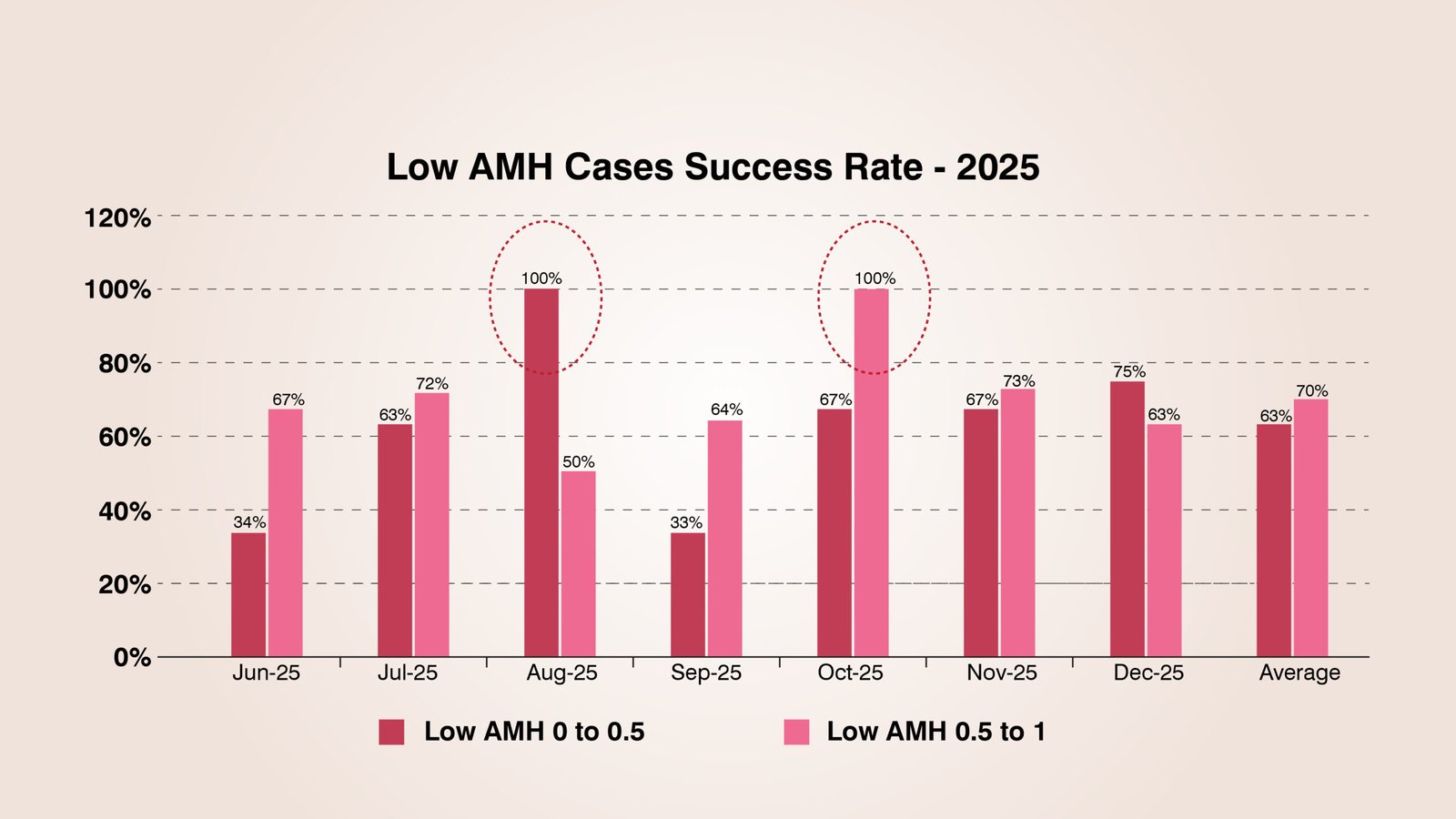
This is why Gunjan IVF World has been delivering more than 70% success rates in Low AMH cases. In fact, the clinic has achieved a 100% success rate in certain months, demonstrating that low AMH does not necessarily mean the end of the fertility journey.
20+ Years Of Experience as Fertility Specialists
20 Years Of Experience as a Fertility Specialists
National Fertility Awards 2023

Call Us
+919990044555
Book An Appointment
Follow Us On
Related Blogs

TSH Normal Range During Pregnancy: A Trimester-Wise Guide
Comprehensive Fertility Treatments | Gynaecology Procedures | Menopause Management | Pregnancy Care | Maternity & Birthing Call +919990044555Understand the trimester-wise TSH normal range during pregnancy, what abnormal TSH levels may indicate, available treatment...

PCOD Symptoms: Early Warning Signs Every Woman Should Know
Comprehensive Fertility Treatments | Gynaecology Procedures | Menopause Management | Pregnancy Care | Maternity & Birthing Call +919990044555Learn about common PCOD symptoms, early warning signs, their link with fertility, and treatments available. PCOD Symptoms...
Follow Us On
About Author

Dr. Gunjan Gupta
Gynecologist and IVF specialist
 Verified & Most Trusted One
Dr. Gunjan Gupta is a Gynaecologist with a specialization in IVF, Infertility & Laparoscopy specialist doctor and has close to 2 decades of experience in : Treating Infertility, Performing Gynae Laparoscopy (Keyhole Surgeries) Handing high-risk Pregnancies. She is a Member of Royal College of Obs and Gynae (MRCOG) of UK and has been trained in Laparoscopy at EUDGES (France).
To book an appointment, call: +919990044555