


What You Need to Know (30-Second Summary)
- Abundant Reserves: Polycystic ovaries hold high numbers of resting eggs; the biological challenge is paused ovulation, not absent eggs.
- First-Line Letrozole: Oral letrozole stimulates natural dominant follicle development without thinning the endometrial lining.
- Weight Optimization Impact: Losing just 5–10% of body weight lowers circulating insulin and androgens, often restoring spontaneous monthly ovulation.
- Agonist Trigger Safety: When IVF is required, using a GnRH agonist trigger reduces ovarian hyperstimulation risk to virtually zero.
- Frozen Transfer Advantage: Freezing embryos and transferring in a calm subsequent cycle allows high stimulation estrogen to clear, boosting implantation.
A diagnosis of Polycystic Ovary Syndrome does not mean you cannot have a child. Let us dispel that myth once and for all.
Every day in our Indirapuram and Noida centres. Young women sit in our consultation rooms clutching ultrasound reports.
"PCOS fertility care requires restoring metabolic balance first. When we address insulin resistance and quiet systemic inflammation, ovarian response and egg quality improve dramatically."
They have read alarming articles online. They believe their ovaries are permanently damaged by cysts. They worry they will never hear the sound of a baby crying in their home.
The truth is the exact opposite.
Women with PCOS do not suffer from a scarcity of eggs. They actually have a generous abundance of eggs.
The challenge is not egg supply; it is egg release.
Your ovaries hold dozens of healthy resting follicles. But subtle hormonal miscommunications prevent them from maturing on schedule.
With the right metabolic guidance and medical support. Over eighty percent of women with PCOS conceive successfully.
What Your Ultrasound Really Shows
What do we see on a Day 2 scan? Look at the monitor above your bed.
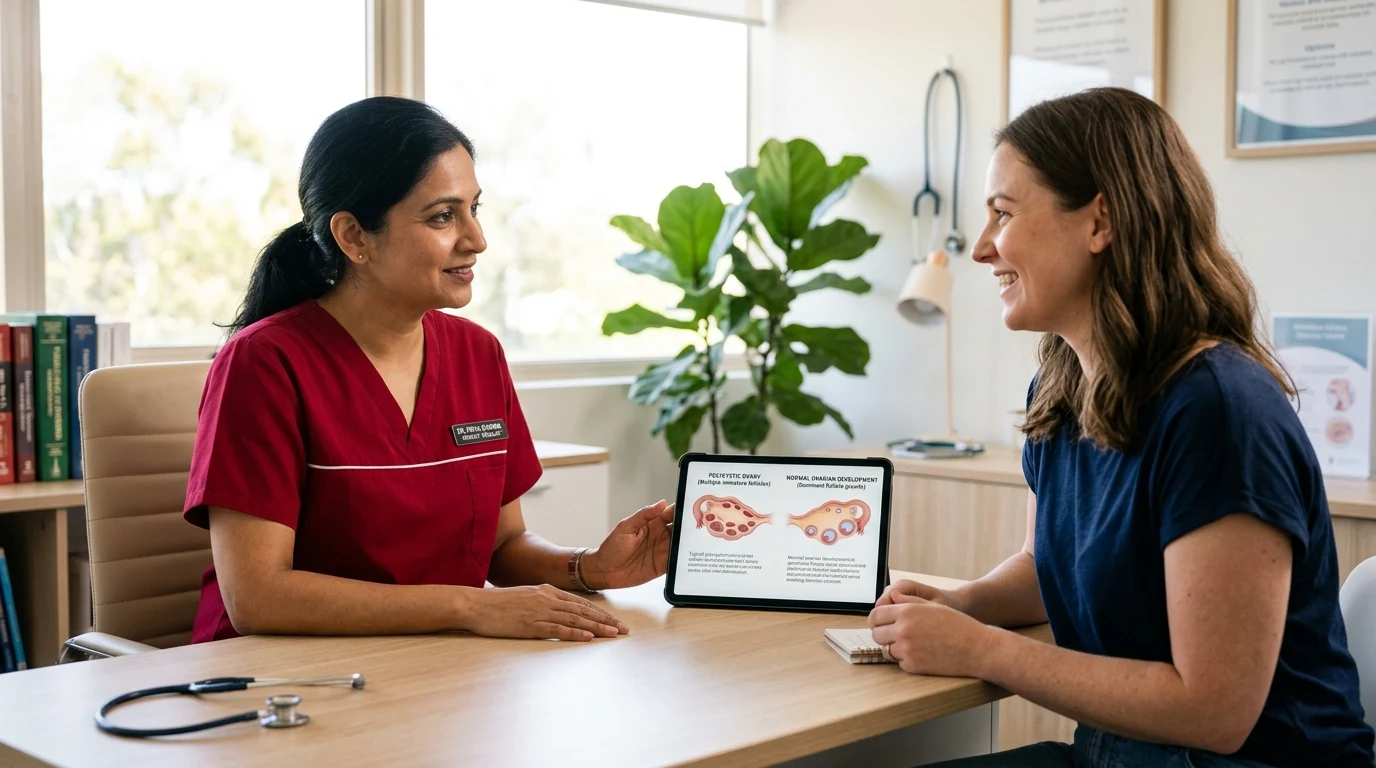
In a typical ovary. We see five to eight small, resting antral follicles measuring two to five millimetres across.
In a polycystic ovary. We see twelve, fifteen, or even twenty-five tiny follicles crowded around the outer edge of the ovary.
Radiologists historically called this a necklace sign or a string of pearls.
These small black circles on the monitor are not abnormal fluid sacs that require surgical cutting. They are completely normal, immature egg follicles.
In PCOS, the central tissue of the ovary, called the stroma, is often enlarged and dense.
The ovary produces slightly higher levels of background hormones, which creates a traffic jam.
One follicle should grow to eighteen millimetres and pop open. In PCOS, the whole group stalls at six millimetres.
Because no follicle pops, ovulation does not happen.
Without ovulation, your body does not make progesterone. Without progesterone, your period does not arrive on time.
The cycle stretches to thirty-five days, forty-five days, or sixty days.
The underlying driver is Insulin Resistance
Why do follicles stall in the first place?
The root cause lies in your body's daily metabolism. Specifically how your cells handle the hormone insulin.
In India, nearly seventy percent of women with PCOS have cellular insulin resistance, regardless of whether their body weight is high, normal, or lean.
When you eat carbohydrates, your digestive system breaks them down into glucose.
Your pancreas secretes insulin to move glucose out of your bloodstream and into your muscle and organ cells for fuel.
In PCOS, your cells do not respond effectively to insulin signals. They resist it.
Glucose remains stuck in your bloodstream.
Your pancreas pumps out double insulin to force sugar into cells.
This flood of circulating insulin has a direct, harmful effect on your ovaries.
Insulin acts on the outer cellular layers of the ovary. Stimulating them to produce excess androgens, commonly known as male hormones, including testosterone.
These elevated male hormones act like a biochemical brake.
They stop ovarian follicles from responding to your brain's natural Follicle Stimulating Hormone, or FSH.
The follicles remain frozen in size, and ovulation grinds to a halt.
Excess androgens also cause the visible symptoms that many women find distressing: stubborn adult acne along the jawline. Thinning hair on the scalp. coarse dark hair growth on the chin, chest, or abdomen.
The Four Pillars of Clinical Management
Treating PCOS effectively requires a structured. Step-by-step approach that starts with metabolism and progresses to medical assistance only as needed.
Nutritional Reset for Indian Diets
Before we prescribe fertility drugs. We address the metabolic fuel you put into your body every day.
Traditional North Indian meals are heavily loaded with fast-acting carbohydrates: white rice. Refined wheat parathas, fried puris, potatoes. sugary tea.
These foods cause immediate spikes in glucose and insulin, fueling the androgen surge.
We guide our patients toward low-glycemic, protein-rich alternatives.
Start your morning with boiled eggs or a warm besan chilla stuffed with grated paneer and spinach.
Swap white rice for brown rice, quinoa, or whole-wheat rotis mixed with sattu flour.
Include a generous bowl of green salad with cucumbers and tomatoes before every major meal. The soluble fiber slows down carbohydrate absorption, keeping insulin levels steady.
Snack on a small handful of walnuts and soaked almonds instead of biscuits or namkeen.
Medical Insulin Sensitizers
Dietary changes provide the base, but targeted medical supplements accelerate recovery.
We frequently prescribe a clinical 40:1 ratio of Myo-Inositol to D-Chiro-Inositol.
Inositol acts as a natural secondary messenger inside your cells. Helping them respond to insulin smoothly. Clinical trials show that consistent inositol therapy lowers circulating testosterone, restores regular menstrual cycles. improves egg quality.
For women with documented insulin resistance or an elevated three-month HbA1c, we add low-dose Metformin.
We start gently with 500 mg taken with water right after dinner to prevent nausea or loose motions. Over four to six weeks, Metformin lowers liver glucose output and dramatically improves ovarian sensitivity.
Monitored Ovulation Induction
When lifestyle adjustments alone do not kickstart ovulation, we assist the ovary with oral medication.
Our primary medical choice is Letrozole.
Letrozole is an oral aromatase inhibitor that gently lowers circulating estrogen for five days. From Day 3 to Day 7 of your bleed.
Your brain senses the drop in estrogen and releases a natural pulse of FSH. Recruiting a single dominant follicle.
Unlike older drugs like Clomiphene. Letrozole does not thin the uterine lining or dry up cervical mucus.
We always monitor Letrozole cycles with serial ultrasound scans in our clinic.
We check your ovaries on Day 2, Day 10, and Day 13.
When the lead follicle reaches eighteen to twenty millimetres and the uterine lining develops a lush. Eight-millimetre trilaminar pattern, our nurse gives a subcutaneous trigger shot.
We advise the couple to have intercourse that night and thirty-six hours later.
Over sixty-five percent of women with PCOS conceive within three to six monitored Letrozole cycles.
Safe Controlled IVF for Resistant PCOS
If a couple does not conceive after six well-monitored ovulation induction cycles. Or if there are additional factors like blocked tubes or low sperm counts, we turn to IVF.
IVF outcomes in PCOS are among the highest in reproductive medicine because egg numbers are generous.
However, treatment must be executed with specialized protocols to avoid Ovarian Hyperstimulation Syndrome, or OHSS.
In our centres, we use an Antagonist protocol with low starting doses of gonadotropin injections, usually 112.5 to 150 IU daily.
We monitor follicle growth every two days with scans and estradiol blood checks.
When the cohort of follicles matures. We trigger egg release using a GnRH agonist, such as Lupride, rather than traditional hCG.
The agonist trigger matures eggs perfectly while allowing hormone levels to plummet within twenty-four hours. Reducing the risk of severe OHSS to zero.
We follow a Freeze-All strategy where we fertilise eggs with ICSI. Culture embryos to Day 5 blastocysts, vitrify them in liquid nitrogen. let the ovaries rest for one month.
In the next cycle. We transfer a single thawed blastocyst into a calm, natural endometrium, achieving pregnancy rates above sixty-five percent.
What Daily Habits Matter Most?
Consistency is far more powerful than perfection.
Walk for thirty to forty minutes every day at a brisk pace. Regular muscle contraction uses up glucose directly without requiring insulin.
Get seven to eight hours of regular sleep. Chronic sleep deprivation elevates cortisol, which directly worsens insulin resistance.
Manage daily emotional stress. High stress hormones signal your ovaries that it is not a safe time for reproduction.
Moving Forward with Hope
Having PCOS is not a personal failure. It is certainly not a barrier to motherhood.
It is simply a metabolic variation that responds exceptionally well to modern science.
Stop listening to outdated myths that tell you your ovaries are defective.
Take practical, structured steps. Nourish your body, balance your insulin, monitor your cycles, and trust the medical process.
Your dream of having a healthy baby is entirely within reach. We are here to walk every step of that path with you.
What to Expect in Our Ultrasound Room on Day 2
When you walk into our clinic for your baseline scan, here is exactly what happens.
Empty your bladder fully before entering the examination room. An overfull bladder tilts the uterus past and blurs ovarian views.
You lie back comfortably on the examination couch. Our nurse provides a fresh sheet for your privacy.
The doctor gently inserts a slim transvaginal probe covered with a sterile sheath.
On the screen above your bed, your ovaries appear in high resolution.
In PCOS, we see a distinctive pattern. A central core of bright, dense stroma surrounded by fifteen to twenty-five small fluid pockets. Each pocket is an antral follicle measuring barely four millimetres.
We measure your ovarian volume. Normal ovaries measure five to seven millilitres. In PCOS, ovarian volume often exceeds ten or twelve millilitres.
We also measure your endometrial lining. At baseline, it should be thin, measuring barely two to three millimetres.
Practical Indian Meal Swaps That Work
You do not need an expensive or complicated diet plan to manage PCOS.
Simple changes to your everyday kitchen make an enormous difference.
Instead of two thick parathas cooked in refined vegetable oil. Have two warm besan chillas mixed with grated paneer and coriander.
Instead of a big plate of white polished rice. Switch to equal parts brown rice mixed with whole green moong dal.
Always drink your morning tea without refined sugar. Add crushed cardamom and ginger for natural warmth.
Drink plenty of water and tender coconut water throughout the day. Staying hydrated keeps digestion smooth and curbs artificial sugar cravings.
📚 Recommended Clinical Guides
Frequently Asked Questions About PCOS and Fertility: What It Really Means for Your Chances of Conceiving
Does having PCOS mean I will definitely need IVF?
No. Most women with PCOS conceive using simple oral ovulation medications like letrozole combined with cycle tracking and timed intercourse. IVF is reserved for cases with blocked tubes, severe male factor, or repeated ovulation induction failures.
Can losing weight help restore natural ovulation?
Yes. Losing just five to ten percent of your body weight significantly lowers circulating insulin and androgen levels. This modest reduction often jump-starts spontaneous monthly ovulation and restores regular periods without medications.
Is pregnancy after PCOS considered high risk?
Women with PCOS have a slightly higher risk of gestational diabetes and elevated blood pressure. Early screening, balanced low-glycemic nutrition, and careful obstetric monitoring keep both mother and baby safe throughout gestation.
Why are frozen transfers better for women with PCOS?
Stimulating polycystic ovaries creates high circulating estrogen levels that shift the uterine receptive window. Freezing the embryos lets hormone levels reset to baseline, creating a far calmer uterine environment for implantation.
Does PCOS affect my egg quality during IVF?
PCOS primarily impacts the metabolic environment surrounding the follicle rather than the genetic integrity of the egg. Managing blood sugar and culturing embryos to Day 5 yields resilient, chromosomally healthy blastocysts.
Does having PCOS mean I will automatically have poor egg quality during IVF?
No. Women with PCOS typically produce large numbers of eggs. While high androgens can affect cytoplasmic maturation, individualized stimulation protocols and Day-5 blastocyst culture consistently yield high numbers of viable euploid embryos.
Why do home ovulation test kits stay positive for days in women with PCOS?
Women with polycystic ovaries often carry chronically high baseline Luteinizing Hormone (LH) levels. Home urine strips detect this background hormone, producing confusing false-positive readings without true egg release.
Can losing five percent of body weight really restore natural ovulation?
Yes. Clinical studies confirm that losing just five to ten percent of baseline body weight significantly reduces circulating insulin levels. This lowers ovarian androgen production and restores natural ovulatory cycles in over half of women.
Does metformin work better than inositol for inducing ovulation in PCOS?
Trials show myo-inositol and D-chiro-inositol match metformin for ovulation and pregnancy. They cause significantly fewer side effects like nausea.
The Path Forward: Taking Your Next Step with Confidence
Polycystic Ovary Syndrome is one of the most manageable fertility conditions when addressed with a structured medical approach. Because women with PCOS have large numbers of resting follicles, our primary clinical goal is regulating insulin sensitivity and restoring predictable, mono-follicular ovulation through evidence-based medical therapy.
Start with a comprehensive baseline assessment that includes an oral glucose tolerance test, lipid profile, fasting insulin, and transvaginal ultrasound. In our practice, the vast majority of PCOS patients conceive successfully with guided lifestyle changes, inositol therapy, and monitored letrozole ovulation induction cycles, keeping IVF as a safe, highly successful secondary option.
Do not let PCOS create unnecessary delay. Dr. Gunjan Gupta Govil and our clinical fertility specialists at Gunjan IVF World provide comprehensive PCOS management tailored to your specific hormonal profile. Visit our centres in Indirapuram Ghaziabad, Janakpuri West Delhi, Noida Sector 49, Greater Noida West, or Meerut to start your personalized plan.