
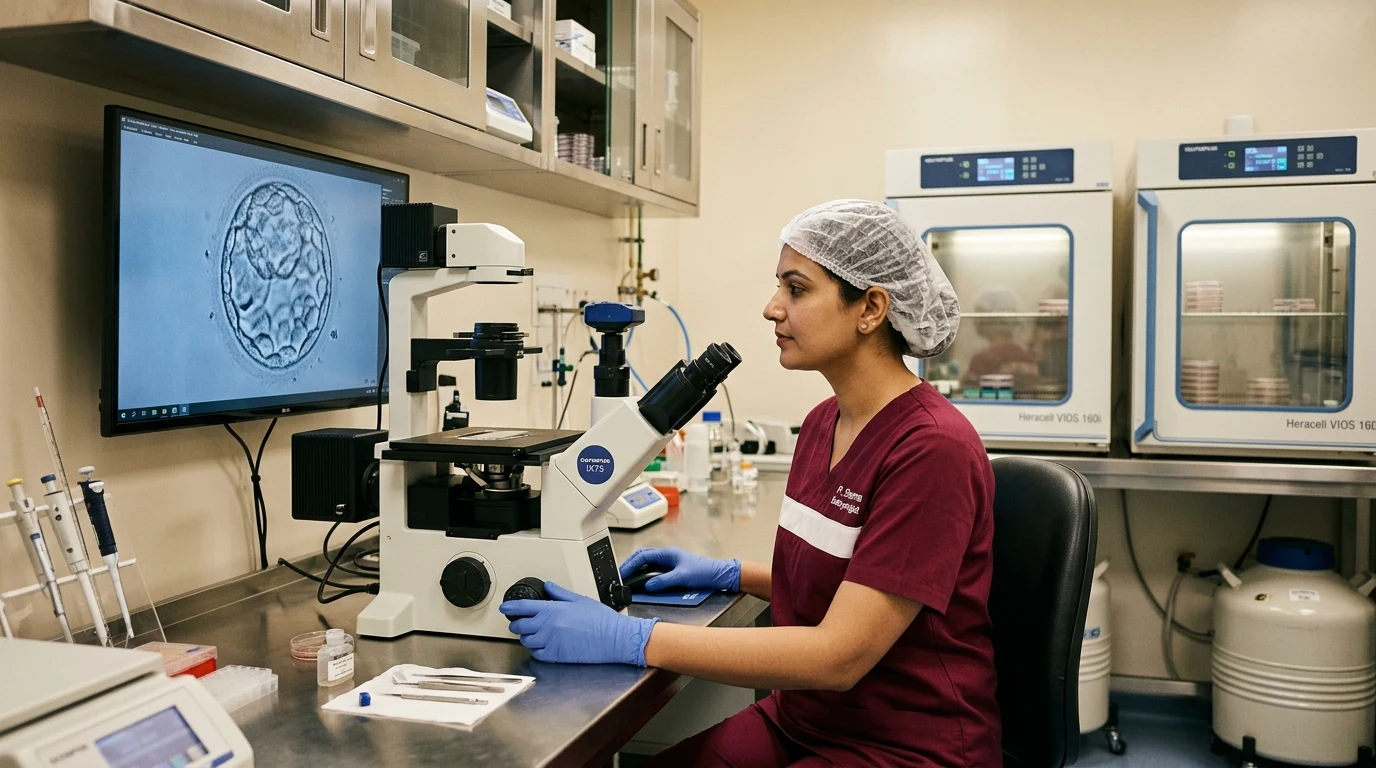


Nearly half of all embryos that look flawless on Day 3 stop growing before reaching Day 5. Transferring on Day 3 does not save a fragile embryo. It forces your body to discover an arrest our cleanroom could identify forty-eight hours earlier.
What You Need to Know (30-Second Summary)
- What is a Blastocyst? A Day 5 or Day 6 embryo with roughly 100-150 cells, showing advanced development and better implantation potential.
- The Advantage: Culturing to the blastocyst stage allows natural selection of the strongest embryos, improving success rates per transfer.
- Day 3 Option: Day 3 (cleavage stage) transfers may be recommended if only a few embryos are available, mimicking the natural tubal environment.
- eSET Policy: Blastocyst transfers facilitate Elective Single Embryo Transfer (eSET), drastically reducing the risks of multiple pregnancies.
- Lab Quality: Reaching the blastocyst stage requires an exceptional embryology lab with strict quality control, a standard at Gunjan IVF World.
When patients reach day three of embryology culture, anxiety runs high. They ask me with trembling voices whether waiting two more days risks losing all their embryos.
"Culturing embryos to Day 5 forces them to prove their cellular stamina. Nearly half of all embryos that look perfect on Day 3 arrest before Day 5 due to embryonic genome activation."
Take a seat. Relax your hands. Let us examine the cellular biology together.
Choosing between a Day-3 cleavage transfer and a Day-5 blastocyst transfer is not a lottery gamble. It is a critical diagnostic filter. Understanding how an embryo develops inside our cleanroom explains why blastocyst culture has revolutionized modern IVF success.
The Day 3 Embryo: Surviving on Maternal Momentum
On Day 3 after egg retrieval, a healthy fertilised egg has divided three times. It contains between six and eight distinct microscopic cells, known as blastomeres.
At this early cleavage stage, the embryo is coasting on maternal momentum. It uses proteins and messenger RNA stored inside the mother's egg before retrieval.
Here is the clinical catch: even embryos carrying severe, fatal genetic errors can look visually beautiful on Day 3. They divide on time because they have not yet tested their own genetic machinery.
Judging embryo potential on Day 3 is like judging a marathon runner after the first hundred metres. Looking good at the start does not prove stamina.
The Day 5 Blastocyst: The True Genomic Handover
Between Day 3 and Day 5, a profound biological milestone takes place. Geneticists call this embryonic genome activation.
The embryo exhausts the mother's stored proteins. It must switch on its own combined DNA, activating paternal genes contributed by the sperm.
This handover is demanding. Embryos carrying chromosomal abnormalities or severe DNA fragmentation stall. They stop dividing and arrest naturally in the culture dish.
Embryos that survive this test expand into 200-cell blastocysts by Day 5. A blastocyst has two distinct cell lineages. The inner cell mass becomes the baby. An outer ring of cells constructs the placenta.
Reaching this milestone proves cellular resilience. A blastocyst has earned its ticket to implantation.
Why Day 5 Blastocysts Deliver Higher Pregnancy Rates
Culturing embryos to Day 5 transforms clinical outcomes in three clear ways:
Double the Implantation Odds: In women under thirty-eight, transferring a single Day-3 embryo yields a pregnancy rate between twenty-five and thirty percent. Transferring a single Day-5 blastocyst immediately doubles those odds, reaching fifty to sixty percent per transfer.
Physiological Timing with Your Womb: In natural biology, fertilisation occurs high inside the fallopian tube. The embryo travels down the tube for four days. It enters the uterine cavity only after becoming a Day-5 blastocyst. Placing a Day-3 embryo into the uterus exposes it to an environment nature never intended. A Day-5 transfer lands in perfect biological sync.
Eliminating Dangerous Multiple Pregnancies: Because Day-3 embryos have lower implantation odds, clinics frequently transferred three or four embryos together to achieve pregnancy. This caused high rates of dangerous triplet and high-risk twin pregnancies. With hardy blastocysts, we practice Elective Single Embryo Transfer. One baby. Full term. Zero maternal compromise.
When Does a Day 3 Transfer Still Make Clinical Sense?
While Day-5 culture is our clinic standard, Day-3 transfers still have a defined role in specific patient groups.
If a patient produces only one or two fertilised eggs on Day 3, culturing to Day 5 offers zero selection benefit. We already know which embryos we have.
While modern benchtop incubators mimic physiological fallopian conditions closely, no machine is completely identical to maternal tissue. For women with low ovarian reserve or repeated lab arrest, a Day-3 transfer provides the natural shelter of the womb.
What Happens to Remaining Blastocysts?
When your cycle yields multiple Day-5 blastocysts, our specialist transfers one fresh embryo or plans an elective frozen transfer.
All remaining blastocysts undergo vitrification. Vitrification is an ultra-rapid cooling technique using liquid nitrogen at minus one hundred and ninety-six degrees Celsius. It turns cellular water into glass in seconds, preventing ice crystals from piercing cell membranes.
These frozen blastocysts remain pristine for years. If your first transfer fails or when you decide to give your child a sibling, we thaw one blastocyst. It maintains an over ninety-eight percent survival rate.
Embryonic Genome Activation: The Day-3 Genetic Hurdle
To understand why Day 5 blastocyst culture is superior, look at embryonic cellular control.
For the first three days, an embryo runs on maternal stores. It uses instructions inherited from the egg cytoplasm.
Even an embryo with missing or broken paternal chromosomes can divide smoothly to eight cells on Day 3.
Between Day 3 and Day 4, a major biological handoff occurs.
The embryo activates its own combined embryonic genome. The father genetic code switches on for the first time.
If that combined DNA carries fatal chromosome defects, the cellular division stalls.
Day 5 culture lets nature filter out arrested embryos. This spares you from undergoing transfers destined to fail.
The Gardner Blastocyst Grading System Explained
Inside our embryology lab, we evaluate Day-5 blastocysts using the standardized Gardner grading criteria.
A blastocyst score contains a number and two letters, such as 4AA or 3BB.
The number (1 to 6) indicates the degree of cavity expansion and hatching. A grade 4 or 5 indicates a fully expanded blastocyst ready to implant.
The first letter (A, B, or C) grades the inner cell mass, which will develop into the baby. An 'A' grade reflects tightly packed, healthy cells.
The second letter grades the trophectoderm, which forms the placenta and gestational sac. An 'A' grade means a cohesive layer of healthy cells capable of robust uterine attachment.
Grading helps us select the single most resilient blastocyst for transfer, maximizing live birth odds while avoiding multiple gestation risks.
The Psychological Relief of Blastocyst Clarity
Waiting five days for laboratory reports can feel emotionally exhausting for any couple.
Patients often ask why we cannot simply transfer on Day 3 to end their anxious waiting.
Consider the emotional arithmetic of failed cycles.
If an embryo carries fatal genetic errors, transferring it on Day 3 does not prevent heartbreak. It forces you to endure two weeks of painful bed rest and progesterone injections, only to face a negative test.
Allowing embryos to culture to Day 5 transfers the waiting period to the laboratory cleanroom.
It spares your body from unnecessary hormone cycles. If a blastocyst forms, you step into transfer day knowing that embryo proved its cellular stamina.
Questions Couples Ask
What happens if none of our embryos reach Day 5?
If all embryos arrest before Day 5, a biological roadblock exists. It points toward high sperm DNA fragmentation or diminished oocyte spindle integrity. While heartbreaking, this diagnostic information saves you from months of futile transfers and directs our team to adjust protocols.
Can a blastocyst split into identical twins after transfer?
Yes, but rarely. A single blastocyst divides into identical twins in roughly one to two percent of transfers. This rate is slightly higher than natural conception due to microscopic manipulation of the outer shell.
Is blastocyst culture more expensive than Day 3 transfer?
Most accredited clinics include Day-5 culture in their comprehensive IVF package. Specialized culture media and extended incubator time involve small laboratory costs, but avoiding failed transfers saves couples substantial money overall.
How do embryologists grade a Day-5 blastocyst?
Embryologists use the Gardner grading system. They assign a number for expansion, followed by two letters for the inner and outer cells. A grade of 4AA or 5AA indicates a highly expanded, top-quality blastocyst.
Can you freeze embryos on Day 3 instead of Day 5?
Yes, but freezing on Day 5 delivers far superior thaw survival and live birth rates. Vitrifying blastocysts ensures you only pay storage fees for embryos with proven developmental stamina.
What if none of our embryos reach Day 5 in the cleanroom?
If an entire cohort arrests before Day 5, it provides vital diagnostic insight. It indicates significant sperm DNA fragmentation, severe oocyte cytoplasmic deficits, or laboratory atmospheric issues that need medical correction before attempting another cycle.
Can an embryo that arrested on Day 3 survive if transferred into the uterus?
Clinical studies show embryos that arrest in an advanced cleanroom incubator with physiological gas control carry fatal chromosomal abnormalities. Transferring them into the uterus does not rescue them; it simply results in a failed transfer or early loss.
The Path Forward: Taking Your Next Step with Confidence
Extending embryo culture to Day 5 blastocyst stage is one of the most significant clinical advancements in modern embryology. Culturing embryos to the blastocyst stage allows our laboratory team to identify embryos that have successfully activated their own embryonic genome, offering significantly higher implantation rates per transfer and allowing safe single-embryo transfer (eSET) to prevent twin complications.
When reviewing your treatment plan, discuss your past embryology records with your doctor. If previous IVF cycles resulted in Day 3 transfers that failed to implant, culturing to Day 5 in a modern Class 10,000 cleanroom with benchtop incubators provides vital diagnostic information regarding embryo developmental competence.
Our senior embryology specialists at Gunjan IVF World utilize advanced culture media and continuous environmental monitoring across our Delhi NCR centres in Indirapuram, Noida Sector 49, Janakpuri, Greater Noida West, and Meerut. Schedule a clinical review to understand how blastocyst culture can optimize your transfer success.