

What You Need to Know (30-Second Summary)
- Inflammatory Microenvironment: Pelvic inflammation from misplaced endometrial tissue alters tubal pickup and causes oxidative stress for eggs.
- Surgical Caution: Removing endometrioma cysts cuts away adjacent healthy follicles, often dropping AMH by 40–50%; assess reserve first.
- Bypassing Tubal Blocks: IVF bypasses distorted anatomy and frozen pelvis by aspirating eggs directly from ovaries and fertilising in the lab.
- Suppression Before FET: Two to three months of GnRH down-regulation before frozen embryo transfer calms uterine inflammation and boosts implantation.
- High Cumulative Success: With customized stimulation and frozen blastocyst transfers, women with endometriosis achieve live birth rates comparable to other couples.
Let us clear up the deepest fear surrounding endometriosis: having this condition does not mean you cannot conceive. Not at all.
Every week in our Indirapuram and Noida clinics, women walk into my consultation room carrying thick files of medical reports. Many have suffered in silence for five, eight, or even ten years.
"Endometriosis is an inflammatory condition that can significantly impact fertility, but it is not a sentence. With the right surgical and reproductive strategy, many women with endometriosis become mothers."
They describe debilitating menstrual cramps that keep them confined to bed. They speak of sharp pelvic pain during intimacy, chronic lower back aches. painful bowel movements during their periods.
Too often, their agony was brushed aside by well-meaning relatives or previous doctors as normal womanhood.
Let us be completely clear. Severe menstrual pain is never normal.
When pelvic pain forces you to miss work, take multiple pain injections, or spend days with a hot water bag, your body is sounding an alarm.
What Actually Happens Inside the Pelvis?
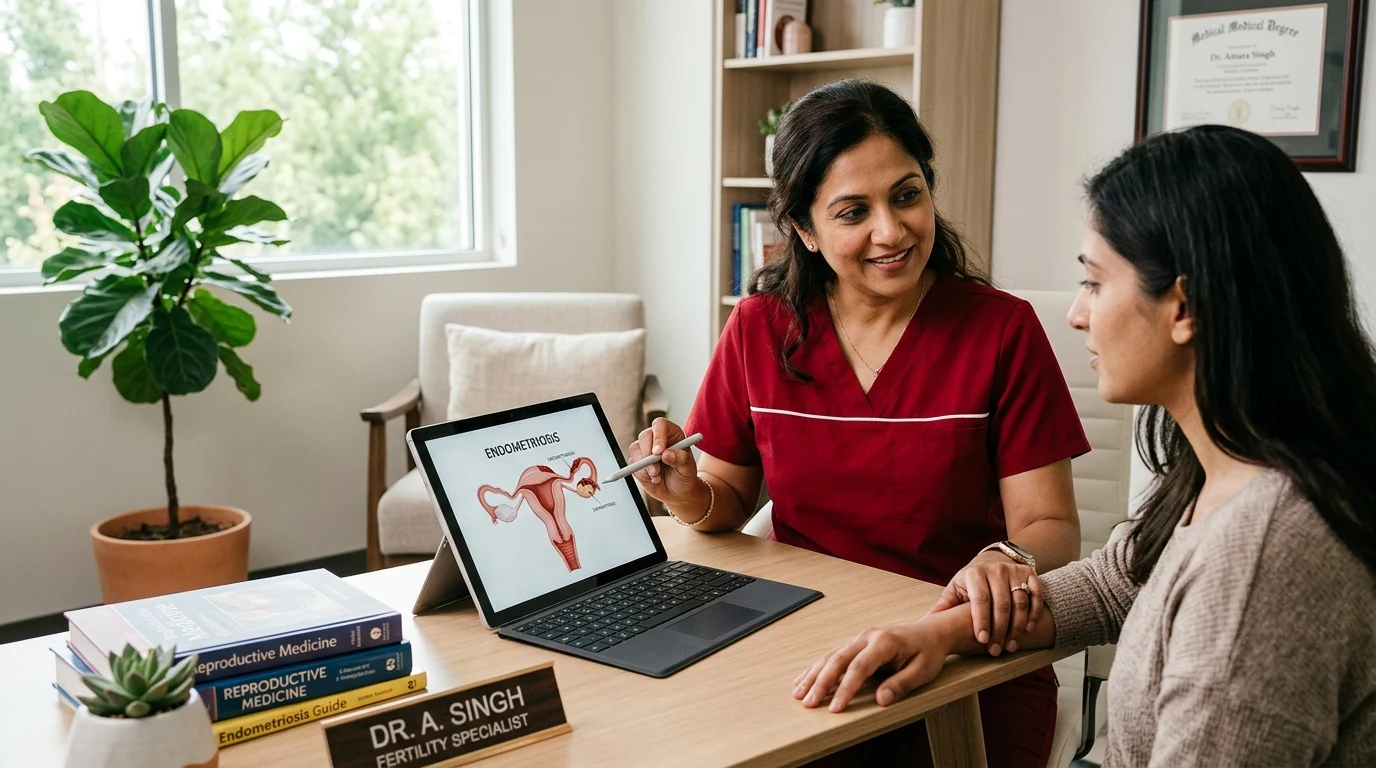
Endometriosis happens when lining cells grow outside the womb. They take root where they do not belong.
They take root on the outer surface of your ovaries, behind the uterus in the pouch of Douglas, along the fallopian tubes. over the bladder and bowel.
Every month, your ovaries produce estrogen and progesterone. The normal lining inside your uterus responds by thickening, breaking down. shedding as your menstrual period.
The misplaced endometriosis tissue responds to the exact same hormonal cues.
It thickens. It breaks down. It bleeds.
Inside your womb, menstrual blood flows smoothly out through the cervix and vagina.
Inside the pelvic cavity, that blood has no escape route. None.
It pools in the pelvis. It triggers intense local inflammation. Your immune system rushes in, trying to clean up the blood.
Over time, chronic bleeding forms dense scar tissue. We call these adhesions.
Organs that should move freely against one another become glued together. The fallopian tubes become kinked. The ovaries get tethered behind the uterus, forming what fertility specialists describe on ultrasound as kissing ovaries.
In severe cases, the entire pelvic floor becomes rigid, creating a frozen pelvis.
Blood builds up inside the ovary month after month. It forms a dark cavity filled with thick fluid. Radiologists call this a chocolate cyst. Radiologists call this an endometrioma, commonly known as a chocolate cyst.
How Endometriosis Impairs Natural Conception
Why does endometriosis interfere with getting pregnant?
It acts through several distinct mechanical and biological barriers.
The primary physical obstacle is structural distortion. If scar tissue binds your fallopian tubes to the pelvic wall, the delicate fimbrial ends cannot sweep across the ovary to pick up an egg. The transport pathway is physically blocked.
Another major barrier is the hostile pelvic environment. The fluid inside the pelvic cavity becomes filled with inflammatory cytokines, free radicals. activated macrophages.
This toxic fluid washes over the fallopian tubes and ovaries. It damages the delicate surface of the egg, immobilizes sperm. impairs early embryo division.
The third challenge is the silent impact on egg reserve. An endometrioma does not just sit inside the ovary; it stretches and thins the healthy surrounding ovarian cortex.
The chronic inflammation inside the cyst accelerates the loss of primordial follicles.
Women with longstanding endometriomas often show a premature drop in their Anti-Mullerian Hormone, or AMH, levels.
When Laparoscopy Hurts Fertility
When women receive an ultrasound report showing a four-centimetre chocolate cyst, the first advice they often receive is surgery.
Many women are told to get the cyst removed by laparoscopy first and then try to conceive.
I urge women to pause and think very carefully before agreeing to ovarian surgery.
Laparoscopy is an exceptional tool for clearing severe pelvic pain. But when the primary goal is having a baby, ovarian cystectomy can be a double-edged sword.
When a surgeon strips the wall of an endometrioma, microscopic strips of healthy ovarian tissue inevitably peel away with it.
Even worse, when thermal electrocautery is used to stop bleeding inside the ovary, the heat chars the delicate remaining follicle bed.
We regularly see young women whose AMH plummeted from 3.5 ng/mL down to 0.6 ng/mL immediately following an aggressive laparoscopic cyst removal. Their pain improved, but their egg supply was devastated.
In modern reproductive medicine, we follow strict clinical guidelines regarding surgery.
If a cyst is under four centimetres without severe pain, we do not operate. Never.
We protect your ovarian reserve at all costs.
If surgery is unavoidable due to severe pain or deep infiltrating disease, it must be performed by an experienced reproductive surgeon using cold scissors and delicate suturing, avoiding destructive electric burns.
How We Approach IVF in Endometriosis
When natural conception or gentle fertility treatments stall, In Vitro Fertilisation offers the most definitive, reliable path to pregnancy.
IVF bypasses pelvic damage entirely.
We do not rely on damaged fallopian tubes to transport the egg. We do not expose delicate sperm and embryos to toxic pelvic fluid.
We retrieve eggs straight from the follicles. We fertilise them in our cleanroom lab. Then we place a healthy embryo gently into the womb.
However, performing IVF in a patient with endometriosis requires specialized clinical expertise.
Ultrasound Guidance and Careful Oocyte Pick-Up
During egg retrieval, the doctor must navigate the ultrasound probe and aspiration needle with absolute precision.
We meticulously avoid puncturing endometrioma cysts.
Puncturing an endometrioma releases thick chocolate fluid into the pelvis, increasing the risk of pelvic infection.
If cyst fluid leaks into the follicular aspirate, it impairs egg quality in the petri dish.
Our embryologists rinse the eggs immediately, placing them in specialized culture media.
We fertilise the eggs using Intracytoplasmic Sperm Injection, or ICSI, ensuring that every mature egg receives a healthy, motile sperm cell.
Every embryo is cultured to Day 5 in our low-oxygen benchtop incubators to reach the robust blastocyst stage.
Freeze-All and Pelvic Downregulation
If you have endometriosis, we never rush into a fresh embryo transfer in the same cycle as egg retrieval.
The high doses of ovarian stimulation raise estrogen levels, temporarily flaring up pelvic inflammation. The uterine lining becomes hostile.
Instead, we vitrify all top-grade blastocysts in liquid nitrogen.
Then, we prepare your pelvis for transfer.
In moderate to severe endometriosis, we often prescribe a depot GnRH agonist, such as Lupride, given as an injection once a month for one to two months.
This medication temporarily pauses ovarian function, inducing a calm, hypo-estrogenic state.
Deprived of estrogen, active endometriosis implants shrink. Pelvic inflammation subsides. Inflammatory cytokines clear from the uterine cavity.
If co-existing adenomyosis is present in the uterine muscle wall, downregulation softens the uterus and restores healthy blood flow.
Once the pelvis is calm, we prepare the endometrial lining using gentle oral estradiol tablets, followed by natural micronized progesterone.
We transfer one single thawed blastocyst under live ultrasound guidance.
By combining careful retrieval, blastocyst culture. medical downregulation before transfer, pregnancy rates in women with endometriosis match those of routine IVF patients, exceeding sixty percent.
Anti-Inflammatory Nutrition and Daily Care
Medical protocols provide the technical cure, but your daily habits create the internal environment for healing.
Endometriosis thrives on chronic systemic inflammation.
Cut down on red meat, deep-fried snacks, refined sugar. processed foods that fuel inflammatory pathways.
Incorporate natural anti-inflammatory foods into your daily meals: fresh turmeric with a pinch of black pepper, walnuts, flaxseeds, cold-pressed mustard oil. deep green leafy vegetables like spinach and fenugreek.
Many women with endometriosis also suffer from irritable bowel symptoms. If you experience chronic bloating, consider reducing dairy and refined gluten for a few weeks to assess whether your pelvic comfort improves.
Engage in gentle, rhythmic physical activity: brisk morning walks, swimming, or pelvic stretching yoga. Movement improves pelvic circulation and clears stagnated blood flow.
Moving Forward with Clarity and Hope
If you have been diagnosed with endometriosis, do not lose heart.
You are not broken. You are dealing with an inflammatory condition that can be managed successfully with intelligent medical planning.
Do not allow pain to be dismissed. Do not rush into repeated ovarian surgeries that burn away your precious eggs.
Protect your reserve. Seek a comprehensive fertility evaluation early.
With modern blastocyst vitrification and tailored hormonal downregulation, holding your own healthy baby is a realistic, achievable reality. We are here to guide you through every single step.
What Happens During a Specialized Pelvic Ultrasound?
You visit our ultrasound room on Day 2 or Day 3. We never rush this scan. Evaluating endometriosis demands advanced transvaginal scanning.
You lie back comfortably on our scan bed. Our nurse covers you with a clean sheet.
We use a high-frequency probe to assess organ mobility. In a healthy pelvis, the uterus, ovaries. bowel glide smoothly past each other when gently pressed. We call this the sliding sign.
In deep infiltrating endometriosis, that slide disappears. The back of your uterus adheres firmly to the bowel wall. The pouch of Douglas is completely obliterated.
We also examine both ovaries carefully. We measure the exact volume of any chocolate cyst. We assess the healthy ovarian tissue surrounding it.
We map out the precise location of every endometriotic nodule before deciding on any treatment.
What Should You Eat to Fight Pelvic Inflammation?
Everyday nutrition plays a powerful supporting role in keeping endometriosis symptoms under control.
Pelvic pain flares when systemic inflammation runs high.
Avoid packaged snacks, white sugar, and deep-fried roadside foods that trigger inflammatory cascades.
Focus on fresh, anti-inflammatory home cooking. Drink warm water with freshly crushed ginger. Add fresh turmeric and black pepper to your daily dal.
Enjoy plenty of dark leafy greens, including fresh spinach, methi, and bathua. Include roasted flaxseeds and a handful of soaked walnuts every morning.
Many women notice that cutting down on dairy and refined maida significantly reduces pelvic bloating and bowel irritation during their periods.
📚 Recommended Clinical Guides
Frequently Asked Questions About Endometriosis and Fertility: Does It Mean You Need IVF
Does pregnancy cure endometriosis?
Pregnancy does not cure endometriosis permanently. However, the high levels of progesterone during pregnancy and breastfeeding suppress estrogen, providing months of natural symptom relief and shrinking active lesions.
Will taking hormone stimulation injections make my endometriosis worse?
Ovarian stimulation causes a temporary rise in estrogen, but standard antagonist cycles last only ten to twelve days. This brief exposure does not cause long-term progression of your condition.
Should I remove my chocolate cyst before starting IVF?
If your cyst is under four centimetres and does not obstruct egg retrieval, leaving it untouched protects your remaining ovarian reserve. We only consider cyst drainage or conservative removal if the cyst blocks needle access to healthy follicles or causes severe acute pain.
Does endometriosis increase my risk of miscarriage?
Once a healthy Day-5 blastocyst implants into a prepared, downregulated lining, pregnancy continues safely. Miscarriage rates match women without endometriosis.
Can a woman with Stage 4 endometriosis have a baby with her own eggs?
Yes, absolutely. Many women with Stage 4 endometriosis deliver healthy live babies using their own eggs. Customized stimulation, cleanroom blastocyst culture, and frozen transfers make this possible.
Does medical suppression before frozen transfer improve endometriosis outcomes?
Yes. Administering two to three months of GnRH depot agonist injections or oral dienogest before your frozen embryo transfer suppresses ectopic inflammatory implants. This calms the pelvic environment and restores normal endometrial receptivity.
Can a woman with stage 4 endometriosis achieve a healthy pregnancy?
Yes. Customized IVF protocols overcome severe endometriosis. Blastocyst culture and hormonal suppression achieve outstanding live birth rates.
The Path Forward: Taking Your Next Step with Confidence
Living with endometriosis presents unique reproductive challenges, but having endometriosis does not mean you cannot have a baby. Whether the condition affects pelvic mobility, causes tubal distortion, or presents as ovarian endometriomas, modern reproductive medicine offers clear strategies to protect your egg reserve and achieve a healthy pregnancy.
Before undergoing repetitive surgical cyst removals that may inadvertently diminish healthy ovarian tissue, obtain a detailed fertility evaluation. A specialized transvaginal scan by an experienced reproductive sonographer, correlated with baseline AMH testing, determines whether direct IVF with a freeze-all protocol is the safest method to secure healthy blastocysts before medical pelvic downregulation.
At Gunjan IVF World, Dr. Gunjan Gupta Govil specializes in complex endometriosis protocols designed to protect ovarian reserve and maximize implantation. Schedule a detailed consultation at our clinics in Indirapuram Ghaziabad, Noida Sector 49, Janakpuri Delhi, Greater Noida West, or Meerut.