
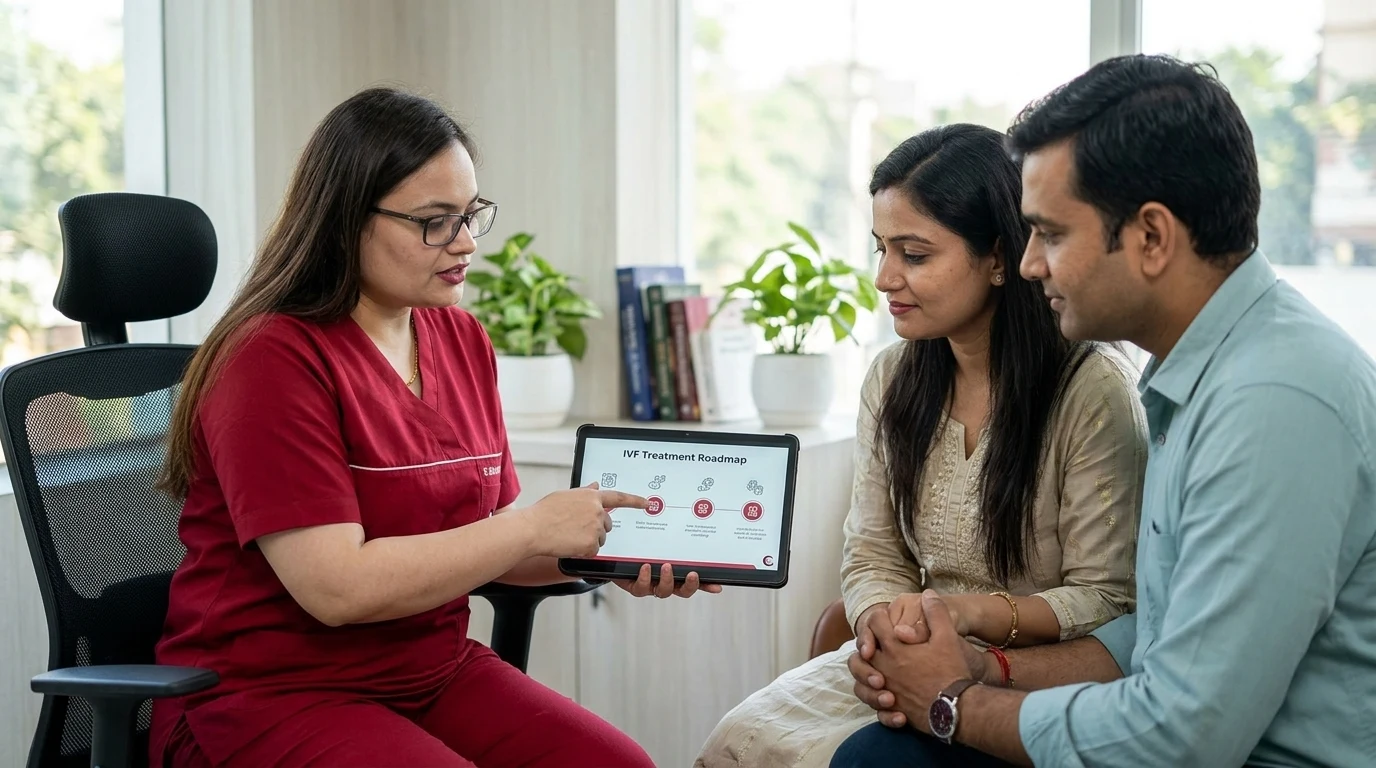

A woman needing IVF often imagines six months of hospital beds and painful surgeries. In clinical reality, the active medical phase takes just twelve days of self-administered micro-injections and a fifteen-minute daycare nap.
What You Need to Know (30-Second Summary)
- Step 1: Stimulation: We use customised GnRH antagonist protocols to gently stimulate the ovaries for optimal egg yield.
- Step 2: Retrieval: Eggs are retrieved under short anaesthesia using ultrasound guidance, a minor day-care procedure.
- Step 3: Fertilisation: Using advanced ICSI under high-magnification optics, we ensure the best sperm fertilises the mature egg.
- Step 4: Culturing: Embryos are cultured to the Blastocyst stage (Day 5/6) to ensure we select the most viable embryo for transfer.
- Step 5: Transfer: A painless procedure where the embryo is placed into the uterus, followed by the two-week wait.
Most couples arrive at our Indirapuram clinic carrying thick folders of confusing printouts. They feel exhausted from months of conflicting advice.
"IVF is not an unguided medical experiment. It is a predictable biological sequence of checkpoints. Each step has an exact timeline, clear physical purpose, and minimal disruption to your daily routine."
Pull up a chair. Set that heavy folder aside. Let's look at your actual calendar together.
IVF follows an orderly biological rhythm. Every step serves a distinct clinical goal, runs on an exact schedule, and causes minimal disruption to your daily routine.
Mapping Your Biological Baseline
Before writing a single prescription, we map your reproductive starting point. This initial assessment takes place during the month before stimulation begins.
We evaluate your ovarian reserve through an AMH blood test and an early cycle antral follicle ultrasound. Your partner completes a detailed computer-assisted semen analysis checking count, motility, and DNA fragmentation.
Indian fertility rules require standard viral screenings for both partners before handling eggs or sperm. We also examine your uterine cavity using saline infusion sonography. This confirms your uterine lining is smooth, healthy, and free from polyps.
Stimulating Ovaries for Ten Days at Home
Your cycle starts on day two or three of your period. In a natural cycle, your ovaries recruit dozens of microscopic follicles but release only one, letting the rest dissolve. Medication simply provides enough follicle-stimulating hormone to nourish that existing monthly group together.
You take daily subcutaneous injections for ten to twelve days. The needle is four millimetres thin, just like a diabetic insulin pen. You inject into your lower belly each evening. It takes twenty seconds and feels like a tiny pinch. Most patients do it themselves while waiting for their dinner to warm.
Between cycle days six and twelve, you visit our clinic for three or four quick morning ultrasound checks. We measure follicle growth in millimetres and track your blood estrogen. Once three or more follicles measure eighteen millimetres, you receive your final trigger shot.
The Trigger Shot: Thirty-Six Hours of Precision
The trigger injection is the most time-sensitive medicine in your entire protocol. It signals eggs inside the follicles to complete their final maturation. They loosen from the follicle wall, ready for retrieval.
We select either an hCG trigger or a GnRH agonist trigger. In women with high follicle numbers or lean PCOS, an agonist trigger reduces ovarian hyperstimulation risks to nearly zero.
Egg collection takes place exactly thirty-four to thirty-six hours later. Timing must match the clock precisely.
Egg Collection Under Light Twilight Sedation
Thirty-six hours post-trigger, you walk into our daycare theatre after fasting overnight.
You do not receive deep general anaesthesia. Our anaesthetist gives you gentle intravenous sedation. You drift asleep in seconds and feel no pain. Guided by ultrasound, our fertility doctor guides an aspiration needle through the vaginal wall to tap each follicle. A gentle suction pump draws follicular fluid into warm glass tubes.
There are no cuts, no stitches, and zero abdominal scars. The collection finishes in fifteen to twenty minutes. Fluid moves immediately through a pass-through hatch into our cleanroom lab.
You wake up ten minutes later in our recovery area. You might experience light period-like cramps. A simple paracetamol and warm tea help you recover quickly. Most women walk out before lunch and spend the afternoon resting on the sofa.
Your partner provides a fresh semen sample that morning. Our andrology team spins and washes the sample in a gradient solution. This filters out seminal debris and isolates the fastest swimming sperm.
Cleanroom Fertilisation and Five Days of Blastocyst Growth
Inside our embryology lab, specialists identify each mature egg under a heated microscope.
When sperm numbers look strong, we perform conventional insemination by placing active sperm around each mature egg. When counts are low or sperm struggle to move, our embryologist performs ICSI. We select a single healthy sperm and place it directly into the egg center.
Fertilised eggs rest inside benchtop incubators calibrated to thirty-seven degrees Celsius and five percent oxygen. Five percent oxygen matches the natural environment of healthy fallopian tubes, shielding growing cells from chemical stress.
By Day 3, an embryo reaches six to eight cells. We culture embryos until Day 5, when they develop into 200-cell blastocysts. Culturing to Day 5 allows nature to filter out weaker embryos with severe genetic flaws. Only sturdy embryos reach this milestone.
Embryo Transfer: Five Minutes Without Anaesthesia
Transfer morning is simple, calm, and memorable. You remain completely awake without needing sedation or pain medicine.
You rest comfortably on the procedure couch. Our doctor guides a soft, flexible catheter through the cervix into your uterus under ultrasound guidance. You watch the screen beside your bed. A tiny flash of air deposits the embryo into the uterine lining.
The entire transfer takes five minutes. It feels similar to a standard smear test. You rest for fifteen minutes, use the restroom, and head home.
Strict bed rest is an unnecessary myth. Your uterus is a muscular organ held together by natural fluid tension, much like two slices of bread holding a pearl. An embryo cannot drop out. You can return to desk work and gentle walking the next morning. A blood test fourteen days later checks your Beta hCG level to confirm pregnancy.
What to Eat and How Your Body Feels During Stimulation
During the first five days of injections, you will feel completely normal. Most women wonder if the medication is even working.
Around day six or seven, your growing follicles begin expanding. Each follicle fills with fluid, and your ovaries enlarge from the size of a walnut to the size of a kiwi.
You will notice a sensation of lower pelvic fullness, similar to the heaviness right before your period. Your abdomen might feel slightly bloated. This physical fullness is normal and expected.
Support your body with high-protein nutrition during this active growth window. Include eggs, paneer, Greek yogurt, lentils, and clean broths in your daily meals.
Drink two to three litres of water daily. Proper hydration supports pelvic blood circulation and keeps you comfortable. Avoid high-sodium restaurant meals that cause unnecessary fluid retention.
Skip high-impact exercises, jumping rope, and deep abdominal twists once your follicles enlarge. Your enlarged ovaries need gentle protection from sudden twisting until retrieval day.
Daycare Recovery and the First Forty-Eight Hours at Home
After egg retrieval, you rest in our recovery lounge for roughly two hours.
Our nursing team checks your pulse and blood pressure. We bring you a cup of warm tea and a light snack once you are fully awake.
You might experience mild, dull pelvic cramping similar to a moderate menstrual flow. A simple paracetamol tablet relieves this discomfort easily.
When you return home, take it easy for the remainder of the day. Rest on the sofa, watch a relaxing movie, and stay well hydrated.
You can resume light desk work and gentle walking the very next morning. Mild spotting for twenty-four to forty-eight hours is normal as the tiny vaginal puncture sites heal.
Take a gentle fiber supplement and drink warm water to prevent constipation. Avoiding abdominal straining keeps your recovering pelvic muscles relaxed and comfortable.
Questions Couples Ask
How many days off work will I actually need?
Most women take off only one morning: the day of egg collection. Stimulation ultrasound visits happen early before work hours. Embryo transfer takes thirty minutes, and you can resume office work the next morning.
Do daily stimulation injections hurt?
No. The needles measure four millimetres and slide in easily. They hurt far less than a standard vein blood draw. Most women give the injection themselves at home in twenty seconds.
What is the difference between fresh and frozen transfers?
A fresh transfer places an embryo five days after collection in the same cycle. A frozen transfer takes place weeks later, allowing ovaries and hormones to settle back to baseline. Frozen transfers deliver higher implantation rates for women with elevated estrogen or PCOS.
Can I exercise during ovarian stimulation?
You can walk comfortably throughout your cycle. However, skip high-impact workouts, heavy lifting, and deep torso twists once ovaries enlarge after cycle day six. This prevents enlarged ovaries from twisting.
What happens to extra healthy blastocysts?
Remaining blastocysts undergo vitrification in liquid nitrogen at minus one hundred and ninety-six degrees Celsius. They stay biologically suspended for years, providing future transfer opportunities without extra injections or retrieval.
Can an embryo fall out if I sneeze, laugh, or use the restroom?
No. Your uterus is a muscular organ held together by natural moisture, like two wet sheets of glass sliding against each other. An embryo cannot drop out or get dislodged by coughing, laughing, or using the bathroom.
What if a tiny drop of medicine leaks onto my skin after injecting?
A single tiny droplet on the skin surface is completely normal. It represents less than one percent of your prescribed dose. Never re-inject or give an extra dose. Simply press the injection site gently with a dry cotton swab for five seconds.
The Path Forward: Taking Your Next Step with Confidence
A successful IVF treatment relies on precision, timing, and close clinical monitoring. From your first stimulation injection on cycle Day 2 to the final blastocyst transfer, each phase follows a calculated medical protocol designed around your ovarian response and hormonal markers. Knowing what to expect at every clinic visit removes uncertainty and allows you to focus on your physical well-being.
Before beginning your cycle, schedule a comprehensive cycle orientation with your fertility team. Request a written calendar outlining your scheduled ultrasound follicular tracking dates, blood draws for estradiol and progesterone, and medication schedules. Ensure both partners complete mandatory infectious disease screenings and baseline semen evaluations well in advance.
Dr. Gunjan Gupta Govil and our experienced fertility specialists guide you through each milestone with clear communication and personal attention at our state-of-the-art clinics in Indirapuram, Janakpuri, Noida Sector 49, Greater Noida West, and Meerut. Book a consultation today to begin your customized IVF treatment plan.