

What You Need to Know (30-Second Summary)
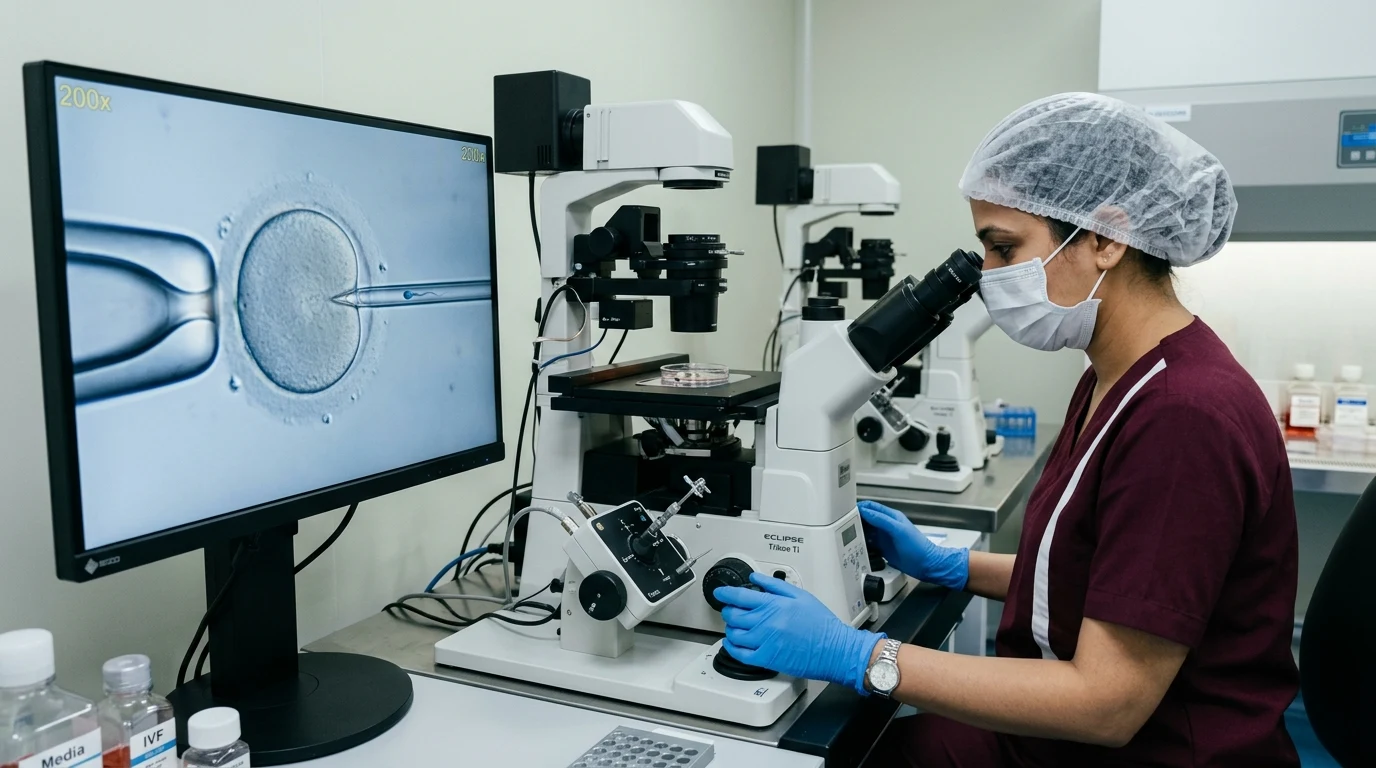
- Direct Micro-Injection: Our embryologist selects a single healthy sperm under 400x magnification and places it directly into the mature egg core.
- Severe Male Factor Solution: Overcomes low sperm count (oligospermia), poor motility (asthenospermia), and high DNA fragmentation.
- TESE/PESA Partnership: Surgically retrieved sperm from testicular tubules cannot penetrate eggs naturally; ICSI enables successful fertilisation.
- Normal Embryo Development: Children conceived through ICSI show the same health, growth, and development milestones as those from conventional IVF.
- Cleanroom Precision: ICSI requires high-vibration isolation tables and specialized micro-manipulators to preserve delicate cellular membranes.
A single viable sperm is enough. Just one. That is the promise of ICSI. It changes everything.
When couples learn that the husband has a sperm count under two million, or motility near zero, despair sets in.
"ICSI has been transformative for male factor infertility. A single healthy sperm is all we need to create an embryo — this technique has given fatherhood to men who were once told it was impossible."
In the past, severe male infertility meant relying on donor sperm or accepting childlessness.
In 1992, reproductive medicine changed forever with the introduction of ICSI.
Today, even if a man produces only a handful of living sperm in an entire ejaculate, or if sperm must be retrieved surgically from testicular tissue, fatherhood is entirely possible.
Understanding the Mechanical Difference: IVF Versus ICSI
To appreciate ICSI, you must understand how standard IVF works.
In conventional IVF, an embryologist places one retrieved egg into a specialized culture dish.
Around that egg, we introduce roughly fifty thousand to one hundred thousand motile sperm.
We place the dish into a benchtop incubator.
The sperm must swim to the egg on their own.
They must penetrate the outer cloud of cumulus cells. They must bind to the protein coat, the zona pellucida. They must release digestive enzymes from their acrosome cap.
Finally, a single sperm penetrates the egg membrane to fertilise it.
Conventional IVF mimics natural selection. It happens in a dish. Sperm swim on their own.
However, that natural selection requires robust parameters. It demands high numbers of progressive swimmers and normal head morphology.
What if count is low. What if motility crawls. Conventional IVF fails cold. Eggs sit unfertilised.
Sperm bump into the egg. They bounce off. They cannot penetrate.
The next morning, the embryologist looks under the microscope. Zero eggs have fertilised.
This is where ICSI intervenes.
ICSI bypasses natural barriers. We do not ask sperm to swim. We do not ask them to drill.
Our senior embryologist takes a single, carefully selected sperm and micro-injects it directly into the cytoplasm of a mature egg.
The physical barriers are completely bypassed.
The Delicate Micromanipulation Procedure
ICSI takes place inside our cleanroom under an inverted research microscope equipped with micromanipulators.
The microscope magnifies four hundred times. Every microscopic detail is visible.
Mechanical joysticks translate the embryologist's hand movements into microscopic steps measured in microns.
The embryologist uses two specialized glass micro-tools.
On the left is the holding pipette. It is a smooth glass tube connected to gentle negative suction. It holds the mature egg securely in place without distorting its shape.
The embryologist rotates the egg until the polar body sits at twelve o'clock or six o'clock.
Why is polar body positioning so critical?
Because the fragile spindle apparatus holding maternal chromosomes sits directly beneath the polar body.
By orienting the polar body away from the injection site, we guarantee that the micro-needle will not touch or damage maternal DNA.
On the right is the injection needle, or micro-pipette.
This hollow glass needle is extraordinarily sharp. It measures barely six to seven microns across, seven times thinner than a human hair.
The embryologist moves the needle into a droplet of viscous polyvinylpyrrolidone solution holding the husband's prepared sperm.
PVP slows the sperm down. It allows the embryologist to evaluate every swimmer in high detail.
We look for normal oval heads, smooth acrosomes, and straight midpieces.
Once the ideal sperm is identified, the embryologist lowers the needle across the sperm's tail.
A quick, decisive tap breaks the tail membrane.
Immobilizing the sperm is mandatory.
A broken tail arrests motility so the sperm remains stationary inside the egg. More importantly, breaking the tail membrane triggers the release of cytosolic activating factors, primarily Phospholipase C zeta. This commands the egg to activate and begin cellular division.
The embryologist draws the immobilized sperm into the tip of the micro-needle.
The needle approaches the held egg at three o'clock.
It presses against the outer zona pellucida. It pierces the shell. It penetrates the inner oolemma membrane.
The embryologist applies gentle aspiration to draw a microscopic droplet of egg cytoplasm into the needle tip.
This confirms membrane rupture.
The embryologist gently expels the cytoplasm back into the egg, along with the single sperm.
The needle withdraws smoothly. The puncture seals in seconds. The egg rests safely.
The injection takes two minutes. That is all. Pure micromanipulation precision.
Clinical Indications for ICSI
We recommend ICSI under specific, evidence-based clinical circumstances:.
When sperm counts drop below five million per millilitre, known as severe oligozoospermia, Sperm counts below five million per milliliter.
When progressive motility falls below twenty percent, termed asthenozoospermia, Progressive sperm motility below twenty percent.
When strict Kruger morphology shows normal shapes under four percent, known as teratozoospermia, Normal sperm morphology below four percent by strict Kruger criteria.
When zero sperm appear in the ejaculate, known as azoospermia, Complete absence of sperm in the ejaculate. Here, sperm are retrieved surgically via PESA, TESA, or Micro-TESE.
For couples with zero or poor fertilisation in past IVF attempts, Cycles where conventional IVF yielded zero or poor fertilisation.
Frozen eggs have vitrified shells that harden significantly. In these cases, Frozen eggs have hardened shells from vitrification. ICSI is mandatory to bypass the toughened zona pellucida.
When performing PGT genetic testing on embryos, PGT-A requires ICSI to prevent stray sperm from adhering to the outer shell. This could contaminate embryonic genetic sequencing.
In couples facing prolonged unexplained delays, In long-standing unexplained delays, ICSI prevents silent fertilisation blocks.
ICSI Success Rates and Embryo Quality
Do injected eggs form blastocysts. Absolutely. Fertilisation rates hit eighty percent.
The data is clear. Blastocyst conversion rates match conventional IVF. Embryo genetics decide the rest.
ICSI achieves normal fertilisation in seventy to eighty percent of mature injected eggs.
Once fertilisation occurs, embryos created via ICSI develop with the exact same cellular velocity, chromosomal competency. Blastocyst conversion rates as embryos created through conventional insemination.
Pregnancy rates and live birth rates depend on embryonic genetics and maternal age, not the injection technique.
Long-term pediatric follow-up studies tracking millions of children born worldwide confirm that ICSI is safe.
Children conceived through ICSI show normal physical, cognitive, and developmental outcomes comparable to naturally conceived peers.
Advanced Sperm Selection Beyond Standard ICSI
In cases of severe male factor, standard visual selection under 400x magnification can be enhanced by advanced technologies.
Physiological Selection with PICSI We often utilize Physiological ICSI, known as PICSI. In this method, sperm are placed in a dish coated with hyaluronan, the same natural substance that surrounds a human egg.
In nature, only biochemically mature sperm with intact DNA bind to hyaluronic acid surrounding the egg.
PICSI uses culture dishes coated with hyaluronic acid hydrogel.
Only mature sperm with low DNA fragmentation bind to the gel. The embryologist selects these bound swimmers for injection.
Magnetic-Activated Cell Sorting (MACS) When sperm DNA fragmentation is elevated, we employ Magnetic-Activated Cell Sorting. This technique uses magnetic nanoparticles to bind and filter out apoptotic, dying sperm.
MACS uses magnetic nanoparticles coated with Annexin V to bind and remove apoptotic, dying sperm before injection.
High-Magnification Selection with IMSI For severe structural defects, our embryologists utilize IMSI. We inspect sperm under 6000x magnification rather than standard 400x, allowing us to identify subtle micro-vacuoles in the sperm head.
IMSI uses specialized optics to magnify sperm over six thousand times.
This extreme magnification allows embryologists to spot microscopic vacuoles in the sperm head that correlate with DNA damage.
A Reassuring Message for Men
Male factor infertility often carries deep, unspoken emotional hesitation.
Men feel defective. They withdraw in silence.
I tell every couple that sperm count is a cellular parameter, not a measure of your masculinity.
ICSI has leveled the reproductive playing field.
You do not need fifty million sperm. You need one living sperm per egg.
With expert andrology preparation, state-of-the-art micromanipulation. Meticulous cleanroom standards, we turn difficult semen reports into healthy babies every single week.
Hold your head high. Science is on your side.
Piezo-Actuated ICSI and Advanced Laser Micro-Tools
In women of advanced maternal age, or in couples with previous failed fertilisation, standard mechanical ICSI can be enhanced with specialized bio-physics.
Standard ICSI uses a sharp, beveled glass needle that mechanically pushes through the outer shell and inner egg membrane.
In fragile oocytes, mechanical pressure can cause sudden membrane tearing or cytoplasm leakage.
To protect delicate eggs, we deploy Piezo-Actuated ICSI.
Piezo ICSI uses an ultra-fine, blunt-ended flat needle connected to a piezo-electric actuator.
The device produces microscopic, ultra-high-frequency vibrational pulses.
These gentle mechanical pulses allow the needle to glide through the zona pellucida and inner oolemma with near-zero distortion of the egg cytoplasm.
Egg survival rates after injection exceed ninety-eight percent, even in women over forty with fragile oocytes.
We also utilize non-contact infrared diode lasers to assist micromanipulation.
The laser delivers microscopic, millisecond pulses of heat that dissolve a tiny circle in the outer protein shell.
This creates an entrance channel for the injection pipette, reducing physical resistance and safeguarding the maternal mitotic spindle.
Artificial Oocyte Activation for Fertilisation Failure
What happens if mature eggs fail to fertilise despite successful sperm injection.
In roughly one to three percent of ICSI cycles, complete fertilisation failure occurs.
Under the microscope the next morning, the egg sits unchanged. No pronuclei appear.
This heartbreaking outcome usually stems from a defect in oocyte activation.
In nature, a fertilising sperm delivers a specific enzyme called Phospholipase C zeta.
This enzyme triggers a rhythmic, oscillating release of calcium ions from internal cellular stores inside the egg.
These calcium waves are the universal biochemical ignition spark for embryonic life.
If the sperm carries mutant or deficient activating enzymes, the calcium spark never occurs. The egg remains asleep.
To overcome this, we deploy Artificial Oocyte Activation, or AOA.
Immediately following ICSI micro-injection, we expose the injected eggs to a specialized chemical activator, such as Calcium Ionophore A23187, for precisely fifteen minutes in our cleanroom.
The ionophore creates temporary microscopic pores in the cellular membrane. This allows calcium ions to flood into the egg cytoplasm.
This artificial calcium wave jump-starts the egg's metabolic machinery.
Artificial oocyte activation restores normal fertilisation rates to seventy percent in couples with previous complete fertilisation failure, turning unexplained defeat into thriving Day-5 blastocysts.
Single Sperm Cryopreservation for Cryptozoospermia
In men with cryptozoospermia, standard semen freezing is impossible.
Cryptozoospermia means only five, ten, or twenty living sperm appear in an entire ejaculate after thirty minutes of searching.
If we freeze such a sample in a standard commercial freezing straw, those ten sperm disperse across a milliliter of fluid and are lost forever upon thawing.
To preserve every single precious swimmer, our cleanroom uses ultra-fine vitrification carriers, such as the SpermVD device.
The embryologist micromanipulates each individual living sperm and places it onto a microscopic micro-droplet on a specialized carrier pin.
The pin is plunged directly into liquid nitrogen at minus one hundred and ninety-six degrees Celsius.
On the day of the wife's egg retrieval, the pin is thawed under the microscope.
Every single frozen sperm is recovered and immediately micro-injected into an awaiting mature egg.
No living sperm is ever wasted. Science finds a way.
📚 Recommended Clinical Guides
Frequently Asked Questions About ICSI
Does ICSI increase the cost of an IVF cycle?
Yes, slightly. ICSI requires specialized micromanipulation workstations, specialized micro-tools, and skilled embryologist expertise. Most clinics charge an additional fee between twenty and thirty-five thousand rupees, which is fully discussed before treatment begins.
Does ICSI ensure that every egg will fertilise?
No procedure commands biological certainty. While ICSI fertilises seventy to eighty-five percent of eggs, some fail to activate. This happens due to inherent chromosomal errors within the egg or sperm.
What is the difference between ICSI and IMSI?
IMSI uses ultra-high digital magnification, up to sixty-six hundred times, compared to four hundred times in standard ICSI. This extreme zoom allows embryologists to inspect tiny vacuole defects in the sperm head, primarily useful for severe unexplained teratozoospermia.
Does ICSI cause birth defects?
No. The risk of major birth defects following ICSI is roughly three percent, identical to the baseline rate in the general population. Any minor increase is related to the parents' underlying genetic subfertility, not the glass injection needle itself.
Can ICSI be done with donor sperm?
Yes. Donor sperm from a registered ART bank pairs safely with ICSI. Choice depends on egg numbers and whether eggs are fresh or vitrified.
Does ICSI increase the risk of physical birth defects?
Extensive international registry data tracking millions of children shows ICSI carries no significant increase in major congenital anomalies compared to conventional IVF. The health and cognitive development of ICSI babies match naturally conceived children.
Can ICSI be performed on immature eggs?
No. ICSI can only be performed on metaphase II (MII) eggs that have completed their first meiotic division. Immature eggs lacking a polar body cannot undergo injection until they reach nuclear maturity in culture.
What happens if the injected egg fails to show two pronuclei the next morning?
At sixteen to eighteen hours post-injection, our embryologist checks for two pronuclei confirming normal fertilization. If zero or abnormal pronuclei appear, it indicates oocyte activation failure or defective sperm centrosomes, guiding protocol adjustments for subsequent cycles.
The Path Forward: Taking Your Next Step with Confidence
Intracytoplasmic Sperm Injection (ICSI) has transformed the clinical management of male factor infertility. By selecting a single morphologically normal, motile sperm and injecting it directly into the cytoplasm of a mature egg, ICSI overcomes severe barriers such as very low sperm count, poor motility, abnormal morphology, or previous complete fertilisation failure under conventional IVF.
If your semen analysis shows suboptimal numbers, do not lose valuable months on non-prescription supplements without a clear medical diagnosis. Bring your semen reports for a detailed andrology review. We assess whether standard ICSI, Physiological ICSI (PICSI), or advanced sperm selection techniques will deliver the highest fertilisation and blastulation rates for your cycle.
Dr. Gunjan Gupta Govil and our specialized andrology and embryology teams provide cutting-edge ICSI solutions across our Gunjan IVF World centres in Indirapuram Ghaziabad, Janakpuri West Delhi, Noida Sector 49, Greater Noida West, and Meerut. Contact our clinical team to schedule your targeted fertility evaluation.