


Growing fifteen egg follicles pushes a woman's estrogen levels ten times higher than nature intended. Placing an embryo into that hormonal storm cuts implantation rates by fifteen percent. Transferring into a calm, natural cycle the following month protects your odds.
What You Need to Know (30-Second Summary)
- The Concept: FET involves thawing and transferring an embryo that was cryopreserved from a previous IVF cycle.
- Vitrification: We use ultra-rapid cooling (vitrification), which prevents ice crystal formation, resulting in a near 100% embryo survival rate.
- Better Uterine Receptivity: Delaying the transfer allows the uterine lining to recover from stimulation medications, often improving implantation.
- The Process: The endometrium is carefully prepared with natural or medicated cycles before the painless transfer procedure.
- Cost and Safety: FET cycles are less invasive, more cost-effective than full IVF, and eliminate the risk of late-onset OHSS.
When I tell patients in Janakpuri we are freezing their embryos instead of transferring immediately, their faces fall. They feel delayed.
"Frozen embryo transfer separates egg retrieval from uterine implantation. Allowing the body to clear high stimulation hormones restores the natural receptive window and boosts live births."
Sit back. Put that disappointment away. That four-week pause is the smartest clinical decision we can make for your body.
A Frozen Embryo Transfer, or FET, is not a second-best consolation prize. In modern fertility medicine, it is the gold standard for implantation safety and success. Understanding the biology of your uterine lining explains why waiting for calm hormonal soil transforms your pregnancy odds.
The Problem with Fresh Embryo Transfers
During ovarian stimulation, daily injections coax ten to twenty follicles to grow.
Each follicle pumps estrogen into your bloodstream. By retrieval day, your serum estradiol can cross three or four thousand picograms per millilitre. In a natural cycle, it rarely exceeds three hundred.
This flood of hormones has consequences. High estrogen accelerates the secretory transformation of your endometrium. It shifts your window of implantation forward by two or three days.
When a Day-5 blastocyst lands, the uterine lining has already aged past its optimal receptive phase. The door is closing.
Stimulation also leaves ovaries swollen and tender. Placing an embryo into that inflamed pelvic environment increases cramping and risks severe Ovarian Hyperstimulation Syndrome if pregnancy hormones kick in.
The Freeze-All Advantage: Vitrification Changes Everything
Decades ago, freezing embryos damaged them. Water inside cells formed jagged ice crystals during slow cooling, tearing delicate cell walls.
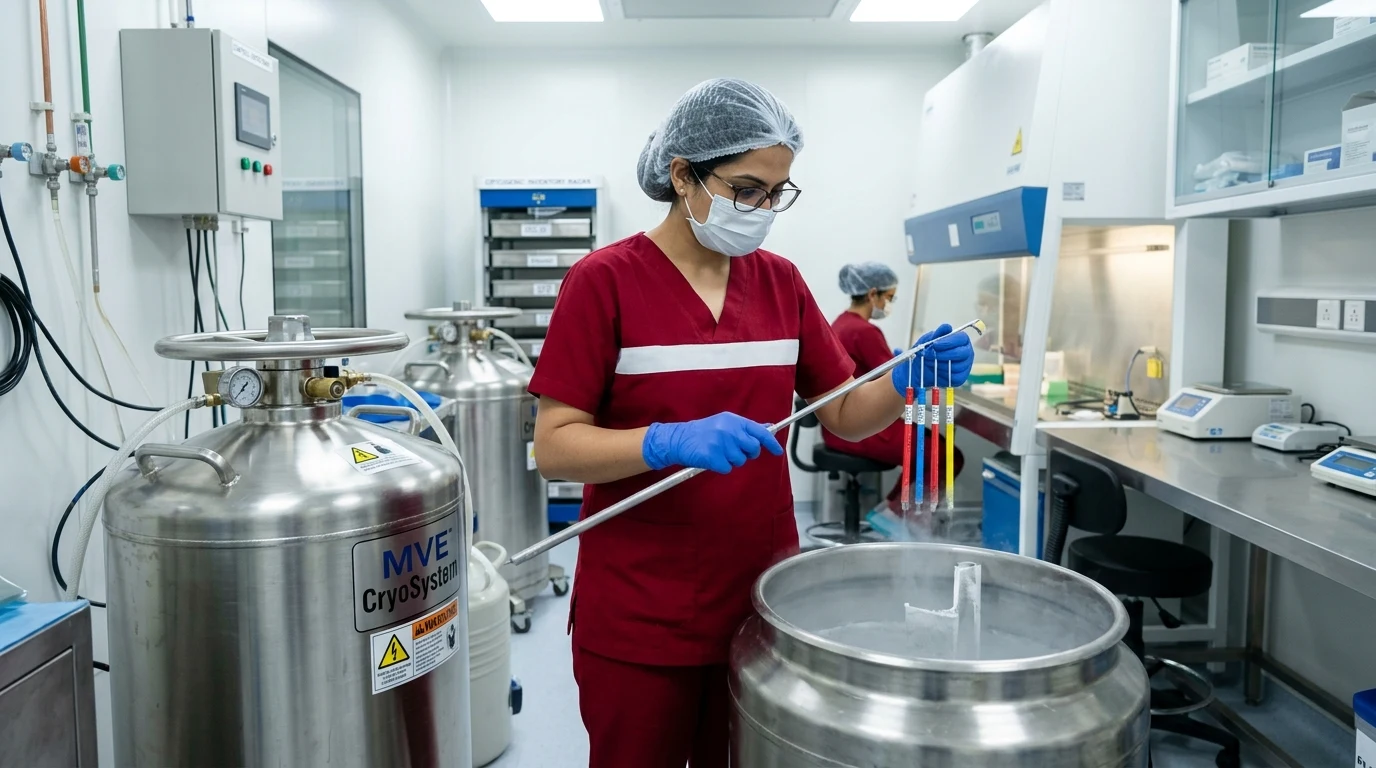
Today, we use vitrification. Our embryologists expose Day-5 blastocysts to specialized cryoprotectants. We plunge them directly into liquid nitrogen tanks at minus one hundred and ninety-six degrees.
The cooling rate is twenty thousand degrees per minute. Water vitrifies instantly into a glass-like solid without forming a single ice crystal.
When thawed months or years later, over ninety-eight percent of blastocysts survive with one hundred percent of their cells intact. Their implantation potential is completely equal to, and often higher than, fresh embryos.
Preparing Your Uterus for a Frozen Transfer
An FET gives us total control over timing. We wait one or two menstrual periods until your ovaries return to normal size and your hormone baseline resets.
We prepare your uterine lining using one of two proven protocols:
The Medicated Hormone Replacement Protocol: This is our most common and predictable approach. Starting on cycle day two, you take mild estrogen tablets to rebuild the uterine lining. Around cycle day twelve, an ultrasound scan measures lining thickness. We look for a plush lining between eight and eleven millimetres showing a crisp triple-line pattern. Once confirmed, we start progesterone support. Exactly five days later, matching the five days your embryo spent growing, we perform the transfer.
The Modified Natural Cycle: For women with regular cycles, we track your natural follicle growth and LH surge. No synthetic estrogen needed. Once your mature egg ovulates naturally, we add mild luteal progesterone and schedule the transfer five days later.
The Five-Minute Transfer Day
Transfer day is identical to a fresh cycle: simple, awake, and pain-free.
Our embryologist thaws your vitrified blastocyst two hours before your appointment. Under a microscope, we verify that the cells have fully re-expanded and resumed biological activity.
You lie comfortably on our examination couch. Guided by an abdominal ultrasound scan, our specialist gently passes a slender, flexible catheter through your cervix. We deposit your blastocyst into the upper uterine cavity.
The procedure takes five minutes. You watch the tiny white air bubble land safely on the monitor. You rest for fifteen minutes and walk out to resume your normal day.
Strict Bed Rest Is Outdated: The Physics of Implantation
Many women believe they must stay flat in bed for fourteen days after transfer. Family members often demand complete rest.
That advice is medically obsolete. Your uterus is not an open hollow jar. It is a collapsed muscular organ lined with mucosal tissue.
Fluid surface tension holds the walls together like two wet glass microscope slides with a drop of water between them. An embryo is smaller than a grain of dust. It cannot fall out when you stand, walk, or use the toilet.
In fact, strict bed rest reduces blood flow to your pelvis and spikes stress hormones. Light daily walking and normal desk work promote uterine arterial circulation and support healthy implantation.
Natural vs Programmed Endometrial Preparation
When planning a frozen embryo transfer, our clinic personalizes your endometrial preparation protocol.
For women with predictable, regular ovulatory cycles, a natural cycle FET offers exceptional biological harmony.
We monitor your developing dominant follicle using serial ultrasound scans starting on day ten.
Once your natural LH surge occurs, your body produces its own endogenous estrogen and progesterone.
We schedule the blastocyst transfer precisely five days after natural ovulation.
For women with irregular periods, PCOS, or busy work schedules, a programmed hormone replacement cycle provides exact scheduling control.
We administer oral estradiol valerate tablets starting on cycle day two to build an endometrial thickness of eight millimetres or more.
Once an ultrasound scan confirms a plush triple-line pattern, we initiate daily micronized progesterone.
Blastocyst transfer is scheduled after exactly one hundred and twenty hours of progesterone exposure.
Both protocols achieve identical, outstanding live birth rates when timed with clinical precision.
Post-Transfer Activity and Travel Guidelines
Immediately following your frozen embryo transfer, you rest comfortably in our daycare recovery lounge for fifteen minutes.
Afterwards, you can empty your bladder, change into your clothes, and walk out to your car.
You do not need bed rest. Strict immobility reduces blood circulation to the pelvis and raises stress hormones.
Return to your normal desk work, gentle walking, and light daily activities the next morning.
Avoid heavy weightlifting, intense aerobic workouts, hot sauna baths, and sexual intercourse until your pregnancy blood test.
The Thawing Protocol: Laboratory Precision Three Hours Before Transfer
Embryo thawing is a rapid, delicate reversal of the vitrification process.
On transfer morning, our embryologist removes your cryo-straw from liquid nitrogen storage at minus one hundred and ninety-six degrees Celsius.
The straw tip plunges instantly into a warm sucrose rehydration bath maintained at thirty-seven degrees Celsius.
This rapid rewarming takes barely one second, completely preventing recrystallization of intracellular water.
Over the next ten minutes, the blastocyst passes through stepped dilution baths. The cryoprotectant wash out gently as natural culture media flows back into the cells.
The thawed blastocyst rests inside a tri-gas benchtop incubator for three hours to re-expand its fluid-filled cavity.
When you walk into our transfer suite, you see your living embryo on the monitor, fully expanded and ready for placement.
Questions Couples Ask
Are babies born from frozen embryos healthy?
Yes, absolutely. Global studies tracking hundreds of thousands of children confirm that babies born from vitrified embryos thrive normally. Birth weights and childhood development match natural conception.
How long after egg retrieval can we do an FET?
Most women complete their transfer four to six weeks after retrieval, starting medications with their next menstrual period. If your ovaries were heavily stimulated, taking a two-month break allows full pelvic recovery.
What is the success rate of a frozen embryo transfer?
Transferring a healthy Day-5 blastocyst into a synchronized uterine lining delivers excellent results. We see pregnancy rates between fifty-five and sixty-five percent for women under thirty-eight.
Do I need daily injections during an FET cycle?
Not necessarily. Most medicated FET cycles rely on oral estrogen tablets and vaginal progesterone suppositories. In some cases, we add twice-weekly subcutaneous progesterone injections for added hormonal stability.
Can frozen embryos remain in liquid nitrogen indefinitely?
Yes. At minus one hundred and ninety-six degrees Celsius, all biological and metabolic activity stops completely. Embryos stored for ten or fifteen years deliver the exact same pregnancy rates as those frozen for one month.
How long can vitrified embryos safely remain frozen in liquid nitrogen?
Indefinitely. Vitrified blastocysts stored at minus one hundred and ninety-six degrees Celsius remain in complete biological suspension. Decades of clinical data confirm that embryos frozen for ten years achieve pregnancy rates identical to embryos frozen for one month.
Why do I need to continue progesterone after a positive pregnancy test?
In a programmed frozen transfer, your ovaries have no active corpus luteum producing progesterone. Supplemental progesterone supports the early pregnancy until the placenta takes over complete hormone synthesis around nine to ten weeks of gestation.
Does freezing embryos for several years degrade their pregnancy potential?
No. Studies show blastocysts frozen for ten years yield identical live birth rates compared to those thawed after one month.
The Path Forward: Taking Your Next Step with Confidence
Frozen Embryo Transfer (FET) offers distinct physiological advantages by allowing your body to recover fully from ovarian stimulation before embryo placement. By separating the retrieval cycle from the transfer cycle, we ensure that the uterine lining is prepared under controlled, physiological estrogen and progesterone conditions, eliminating the adverse hormonal impact of elevated stimulation hormones on endometrial receptivity.
Preparation for FET involves precise monitoring of endometrial thickness and blood flow using transvaginal ultrasound, confirming a triple-line endometrial pattern measuring 8mm or greater before starting progesterone support. The transfer itself is completely painless, quick, and requires no anesthesia or hospital stay.
At Gunjan IVF World, our embryology laboratories achieve thaw survival rates exceeding 98% using advanced vitrification technology. Consult Dr. Gunjan Gupta Govil and our reproductive team at our centres in Indirapuram, Noida Sector 49, Janakpuri, Greater Noida West, or Meerut to plan your personalized FET cycle.