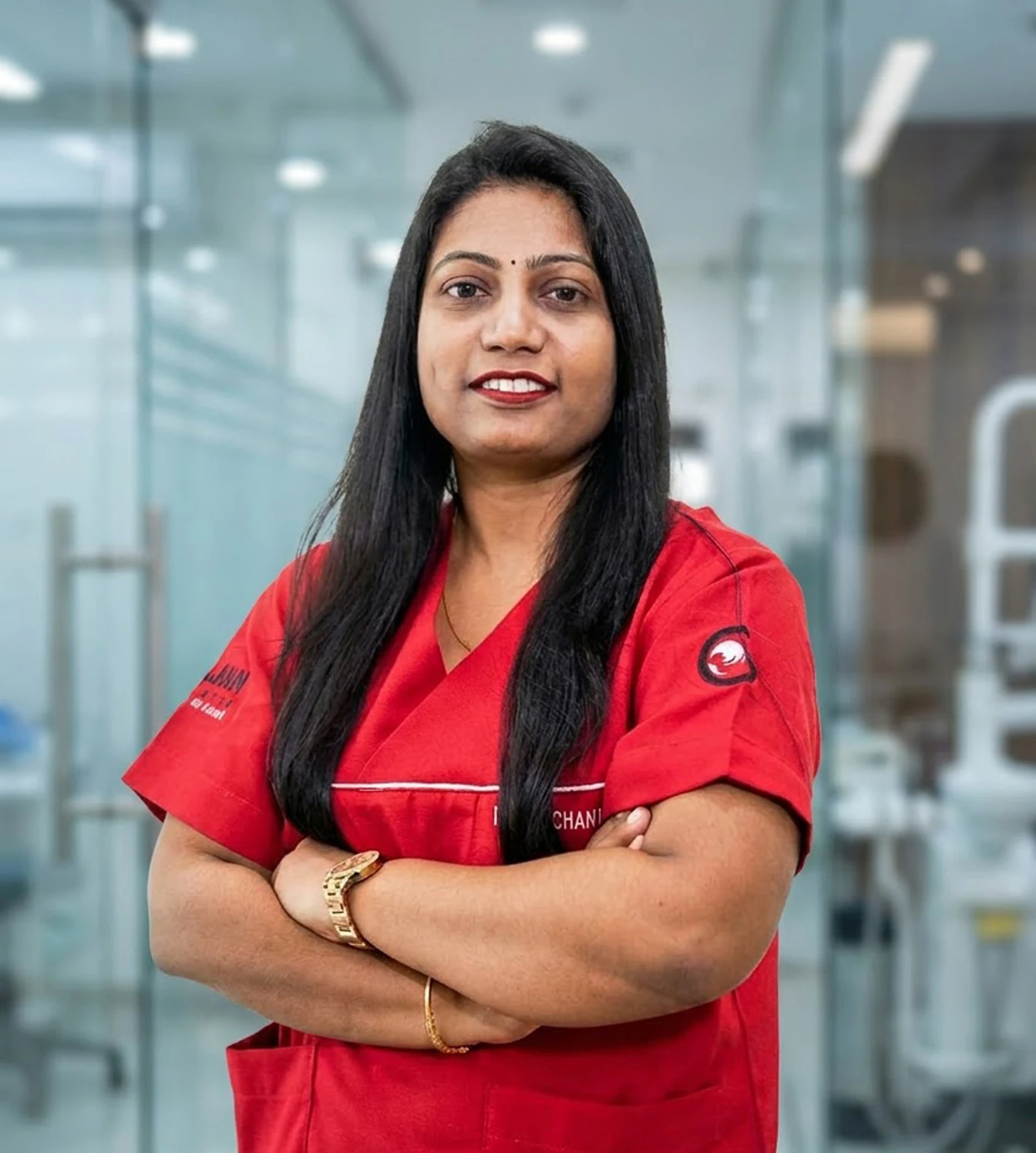
Anonymised clinical case pathways illustrating how Dr. Kanchan Mala approaches complex fertility and reproductive challenges.
IVF Success Despite Low AMH
IVF Success at 40: Overcoming Low AMH with Personalized Fertility Treatment
A 40-year-old woman with 0.33 ng/mL AMH approached us after being advised elsewhere to consider donor eggs for IVF. We discussed an individualized treatment option incorporating ovarian rejuvenation, aiming to attempt conception using her own oocytes. We planned embryo pooling through two controlled ovarian stimulation cycles, carefully designed to maximize her chances of retrieving mature oocytes, and achieving viable embryo development despite her diminished ovarian reserve and low ovarian response.
After comprehensive counselling, we advised the couple to pursue individualized IVF treatment using her own oocytes rather than proceeding with donor eggs. Ovarian rejuvenation was incorporated as an adjunct, followed by two stimulation cycles for embryo pooling. Two mature MII oocytes were retrieved, and both developed into blastocysts. Following embryo transfer, she achieved a singleton pregnancy. Nine months later, she delivered a baby boy, marking a successful IVF outcome achieved with her own eggs and offering hope for selected patients.
Recurrent Pregnancy Loss to IVF Success
Overcoming Recurrent Pregnancy Loss Through Advanced Sperm Selection and Precision IVF Treatment
A 33-year-old couple visited us after experiencing 4 heartbreaking pregnancy losses. Despite extensive investigations showing no obvious abnormality, successful pregnancy was told to be difficult for them. Their hope was gradually fading. We looked beyond routine tests and recommended sperm DNA fragmentation testing. The DFI was found to be remarkably high at 83%. We then counselled the couple toward an individualized IVF approach with advanced sperm selection.
We proceeded with IVF using a microfluidics-based sperm selection approach to identify sperm with improved DNA integrity, followed by embryo development and genetic testing. Six embryos were obtained, of which four were identified as euploid on preimplantation genetic testing. After detailed counselling, two euploid embryos were transferred, resulting in a singleton pregnancy. She is now eight months pregnant and is expected to reach term in the coming month. This case highlights individualized evaluation and treatment in recurrent pregnancy loss.
Overcoming IVF Failure Through Hysteroscopy
Patient undergoing repeated IVF failure experienced healthy motherhood after hysteroscopy.
A 35-year-old woman with a previous early miscarriage underwent D&C, after which her menstrual cycles became irregular. She subsequently underwent three IVF attempts without achieving pregnancy. When she consulted us, considering her history of repeated IVF failure and menstrual irregularity, we planned a hysteroscopic evaluation to assess the uterine cavity for any correctable pathology that could potentially affect endometrial receptivity and implantation before proceeding with another individualized IVF treatment cycle.
Hysteroscopy revealed an intrauterine adhesion band, which was carefully removed. During the procedure, endometrial rejuvenation was also performed, and an endometrial biopsy was obtained. The biopsy indicated infection, for which appropriate antibiotics were prescribed. After completing treatment, we proceeded with an individualized IVF plan. She successfully conceived following embryo transfer and subsequently delivered a healthy baby, achieving a successful pregnancy and live birth after three previous unsuccessful IVF attempts.