
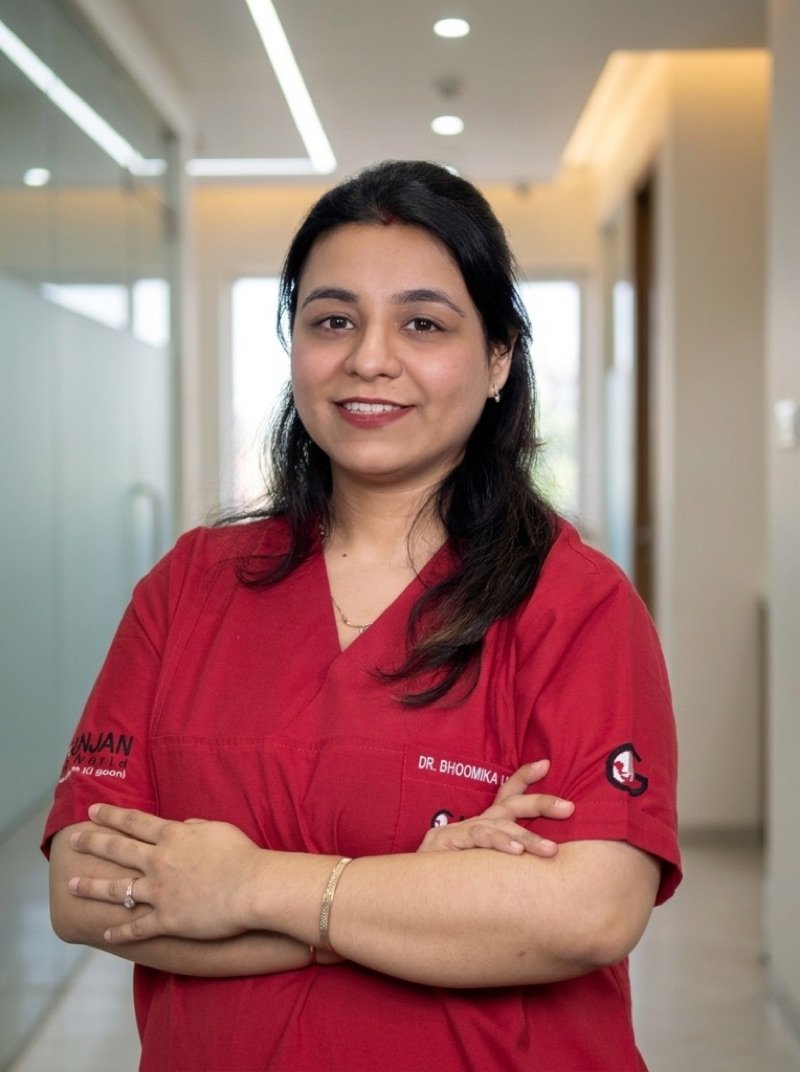
Dr. Bhoomika Upadhyay
MBBS · MS (Obs & Gynae) · Fellowship in Reproductive Medicine (ART, Birla Fertility) · FMAS · DMAS · Fellowship in Hysteroscopy
"Every fertility journey is different. I believe in understanding the person behind the diagnosis and creating a treatment plan that is personalised, evidence-based and transparent."
Why Patients Who Have Been Elsewhere Come Here
When you meet Dr. Bhoomika Upadhyay, the focus is on understanding your complete fertility journey. She combines her training in Obstetrics & Gynaecology, Reproductive Medicine and ART with a personalised approach to diagnosis and treatment. Whether you are starting your fertility journey or have faced challenges before, the aim is to understand what has happened, explain your options clearly and plan the next step together.
Core Principles of Your Treatment
Every clinical decision is governed by rigorous medical evidence, personalized stimulation mechanics, and patient safety.
Your Fertility Plan Should Be Personalised to You
Fertility treatment is not a one-size-fits-all process. Your age, ovarian reserve, medical history, previous treatment and response to medication all matter. Treatment is planned around your individual clinical profile, with the aim of using the right approach rather than simply repeating a standard protocol.
Previous Treatment Does Not Define Your Next Attempt
If you have experienced an unsuccessful IVF cycle or another fertility treatment, the next step is to understand why. Previous reports, ovarian response, embryo development, uterine assessment and other relevant factors can be reviewed together before planning further treatment.
Look at the Uterus Before Embryo Transfer
A careful assessment of the uterus can be an important part of fertility care. Where clinically indicated, ultrasound and hysteroscopy can help identify conditions such as polyps, fibroids, adhesions or other abnormalities. Finding and addressing relevant factors before embryo transfer can help ensure that the uterus is appropriately assessed for treatment.
Every Treatment Governed by Tripartite Clinical Consensus
At Gunjan IVF World, no patient is treated by an isolated practitioner. Your fertility roadmap unites primary consultant care, precision embryology leadership, and centralized medical director oversight.
Medical Credentials & Certifications
Verified academic credentials, licensing, medical council registrations, and professional society memberships for Dr. Bhoomika Upadhyay.
Academic Qualifications
- Degree / CredentialMBBS — Hamdard Institute of Medical Sciences (HIMSR, New Delhi)
- Degree / CredentialMS (Obstetrics & Gynaecology) — SMS Medical College, Jaipur
- Degree / CredentialFellowship in Reproductive Medicine & Infertility
- Degree / CredentialAdvanced Fellowship in Gynecological Laparoscopy
Council Registrations & Licensing
- Verified Statutory Registration Registered with Delhi Medical Council & Rajasthan Medical Council
- ART Act 2021 Statutory Compliance Registered ART Specialist adhering to the National ART & Surrogacy Board Guidelines
- Evidence-Based Protocol Adherence Adherence to ESHRE, ISAR, and national reproductive medicine clinical guidelines
Professional Memberships
- Professional SocietyMember, Indian Society for Assisted Reproduction (ISAR)
- Professional SocietyMember, Indian Fertility Society (IFS)
- Professional SocietyMember, FOGSI
Honours & Recognition
- Clinical RecognitionAcademic Honors in Reproductive Surgery
- ET Healthworld IVF Chain of the YearProud clinical faculty member of 4-time consecutive award-winning fertility network
- Continuous Medical EducationInvited clinical faculty and participant at national conferences (ISAR, IFS, ACE)
Professional Career & Institutional Appointments
7+ years of progressive clinical and laboratory leadership across premier healthcare institutions.
Specialised Clinical Procedures & Interventions
Focused clinical proficiencies developed over thousands of individualized treatments:
Stories From the Consulting Room
Illustrative cases. Names are changed to protect privacy.
[ADD REAL DE-IDENTIFIED CASE: e.g. Failed IVF / Implantation Failure]
[ADD PATIENT-VOICE HEADLINE FROM A REAL CASE]
[ADD REAL DE-IDENTIFIED CASE CONTEXT, max 70 words]
[ADD REAL DE-IDENTIFIED CASE OUTCOME/RESOLUTION, max 80 words]
Low AMH / Poor Ovarian Reserve
I wasn’t ready to give up on my own eggs.
At 38, with an AMH of 0.5 ng/mL, she and her 42-year-old husband were looking for one more chance to conceive with her own eggs. Other doctors had suggested donor eggs, but she was not ready to give up on that possibility. She came to us determined to explore what could be achieved with her own eggs.
In the first stimulation cycle, one mature egg was retrieved and developed into a blastocyst. In the second cycle, another mature egg was retrieved and again developed into a blastocyst. Both blastocysts were transferred, resulting in a twin pregnancy. She went on to have a successful delivery and is now a happy mother of twins.
Male Infertility / Azoospermia
We found a way forward with own sperm.
The couple came with a significant fertility challenge: the woman had PCOS, while the husband had azoospermia. They were not willing to use donor sperm and wanted to explore every possible option using his own sperm. After thorough examination and hormonal evaluation, the couple was counselled about the available options.
Micro-TESE was performed to look for sperm directly from the testes, and sperm was successfully retrieved. ICSI was then performed, embryos were formed and transferred, and the patient conceived. She subsequently delivered a healthy baby boy.
Publications, Teaching and Talks
Training
Fellowship in Reproductive Medicine & ART
Completed Fellowship training in Reproductive Medicine and Assisted Reproductive Technology at Birla Fertility & IVF, Noida, with exposure to fertility evaluation, IVF treatment planning and ART-related clinical care.
Training
Fellowship in Diagnostic & Operative Hysteroscopy
Completed fellowship training in Diagnostic and Operative Hysteroscopy, with focused training in hysteroscopic evaluation and management of intrauterine pathology relevant to fertility care.
Training
Fellowship & Diploma in Minimal Access Surgery
Completed Fellowship and Diploma training in Minimal Access Surgery, strengthening skills in minimally invasive gynaecological surgical assessment and management.
Training
Research in Reproductive Medicine & ART
Academic work includes a prospective observational study evaluating autologous intrauterine platelet-rich plasma instillation and pregnancy outcomes in women undergoing frozen embryo transfer after a previous implantation failure.
Frequently Asked Questions
Clear answers to the most common questions patients ask before their first appointment.
How do I book a consultation with Dr. Bhoomika Upadhyay?
You can contact the centre directly to request an appointment. During your first consultation, bring any previous fertility reports, scans, IVF summaries and relevant blood tests you have. If you do not have all your records, that is completely fine. The consultation will focus on understanding your history and deciding what needs to be assessed next.
What should I bring to my first fertility consultation?
Bring previous IVF or fertility treatment records, ultrasound reports, hormone tests, semen analysis reports and any operative or hysteroscopy reports you have. If you have undergone IVF before, an embryology or cycle summary can also be useful. Do not worry if some records are unavailable.
I have had a failed IVF cycle. What should I do next?
A failed cycle does not by itself determine what will happen in the future. The previous cycle can be reviewed in detail, including ovarian response, stimulation, egg and embryo development, transfer details and uterine assessment. Depending on your history, additional evaluation may be appropriate before planning another attempt.
Do I need IVF, or can I try other fertility treatments first?
Not everyone needs IVF. The appropriate treatment depends on factors such as age, duration of infertility, ovarian reserve, ovulation, tubal status, semen parameters and previous treatment. After reviewing your history and investigations, the options can be discussed so that you understand why a particular approach is being considered.