

What You Need to Know (30-Second Summary)
- Scrotal Hyperthermia: Venous blood pooling elevates testicular temperature by 2°C, halting spermatogenesis and elevating sperm DNA breaks.
- Clinical Grading: Physical examination classifies varicoceles into Grades 1–3; subclinical varicoceles seen only on ultrasound rarely warrant surgery.
- Gold Standard Microsurgery: Subinguinal repair under 15–20x magnification preserves arteries and lymphatics with a recurrence rate under 2%.
- Semen Recovery Timeline: Sperm regeneration takes 74 days; significant improvements in count, motility, and DFI appear between 3–6 months.
- Tactical Decision: Repair is ideal if female partner is under 35; if female age is 38+ with low AMH, proceeding straight to ICSI saves precious ovarian time.
A varicocele is common. It is correctable. But deciding on surgery requires careful calculation. Time is precious.
When a man is diagnosed with a varicocele, he often feels anxious.
"Varicocele is the most common surgically correctable cause of male infertility. Whether surgery or IVF is the better path depends on severity, partner age, and semen parameters — each case requires individualised counselling."
He hears the word "vein dilation" and wonders if he needs immediate surgical repair.
In our Indirapuram and Noida clinics, we consult hundreds of men with varicoceles every year.
Some men need surgery immediately.
For others, surgery would waste precious reproductive time. Proceeding directly to IVF or ICSI is the far wiser medical choice.
Making the right decision depends on clinical grade, semen parameters, sperm DNA fragmentation. Crucially, the female partner's age and ovarian reserve.
What Is a Varicocele?
A varicocele is an abnormal enlargement and tortuosity of the pampiniform venous plexus in the scrotum.
A varicocele is varicose veins of the scrotum. Valves fail. Blood pools in the sac.
The pampiniform plexus is a specialized vascular network that drains venous blood from the testis.
It also serves as a critical counter-current heat exchanger.
Human testes sit outside the body. Why. Because sperm need coolness. They require a temperature two degrees cooler than core body heat.
Arterial blood entering the scrotum is cooled by the surrounding venous network before reaching testicular tissue.
Inside a varicocele, the one-way valves inside the internal spermatic veins fail.
Blood does not flow smoothly back toward the heart.
Instead, warm venous blood refluxes and pools inside the scrotal sac.
Eighty-five percent occur on the left. The left vein takes a vertical path. It enters the renal vein at ninety degrees. Hydrostatic pressure builds up.
Why the left?
The left vein travels a vertical path. It enters the renal vein at ninety degrees.
This anatomical configuration creates high hydrostatic pressure, predisposing left-sided valves to failure.
However, bilateral varicoceles are present in roughly thirty to forty percent of men when examined carefully with ultrasound.
How Varicoceles Destroy Sperm Quality
A varicocele damages the testicular factory through three toxic biological mechanisms:.
Elevated Scrotal Temperature Testes sit in the scrotum because sperm development requires a temperature two degrees cooler than the body core. Dilated veins create pooling blood that overheats the sperm factory.
Pooled blood elevates scrotal temperature. Testes overheat. Heat kills dividing germ cells.
This persistent heat shock paralyzes temperature-sensitive enzymes required for spermatogenesis.
Germ cells undergo apoptosis. This leads to progressive drops in sperm count.
Venous Stasis and Tissue Hypoxia Sluggish blood flow prevents fresh, oxygenated arterial blood from reaching developing germ cells, starving them of essential cellular nutrients.
Sluggish venous drainage deprives the testicular tissue of fresh, oxygenated arterial blood.
The seminiferous tubules suffer chronic microvascular hypoxia. This leads to cellular degeneration and poor progressive motility.
Oxidative Stress and DNA Fragmentation Stagnant blood allows reactive oxygen species to flood the testicular tissue, fracturing the delicate DNA strands inside the sperm head.
Stagnant venous blood carries toxic metabolites and elevated levels of reactive oxygen species.
These free radicals overwhelm the testis's natural antioxidant defenses.
They attack the unsaturated fatty acids in sperm cell membranes, destroying motility and causing abnormal head morphology.
Free radicals fracture paternal DNA strands. The DNA Fragmentation Index climbs. It often crosses thirty percent.
Understanding Clinical Versus Subclinical Varicoceles
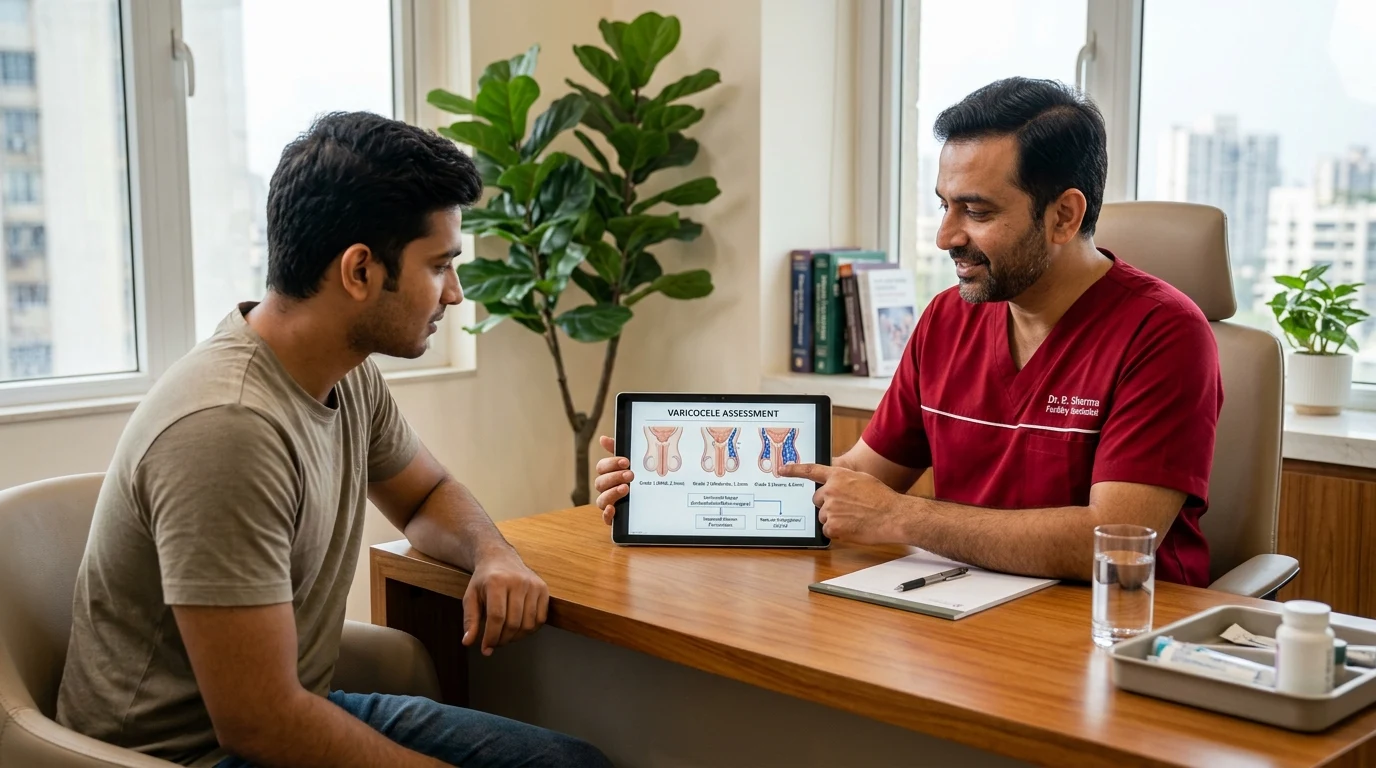
In andrology, accurate clinical grading determines treatment eligibility:.
A subclinical varicocele cannot be felt by hand and is detected only on scrotal Doppler ultrasound. Not visible and cannot be felt during physical examination, detected only by scrotal color Doppler ultrasound. International guidelines state that subclinical varicoceles should never be surgically repaired for fertility purposes. Surgery provides zero benefit.
A Grade 1 varicocele is small and palpable only when the patient stands and bears down. Small, felt only when bearing down while standing.
A Grade 2 varicocele is moderate in size and easily palpable while standing without bearing down. Moderate, easily felt during physical examination while standing, but not visually prominent.
A Grade 3 varicocele is large and visible through scrotal skin, resembling a bag of worms. Large, visible through the scrotal skin across the room, resembling a "bag of worms".
Microsurgical Varicocelectomy as the Surgical Gold Standard
If surgery is indicated, the choice of surgical technique is paramount.
In the past, surgeons performed open high-ligation surgeries (Palomo or Ivanissevich procedures) or laparoscopic clipping.
Older techniques had fifteen percent recurrence. They risked accidental artery injury or hydrocele formation.
Today, the undisputed global gold standard is Microsurgical Subinguinal Varicocelectomy.
We use an operating microscope. We work under fifteen-times magnification through a tiny groin incision.
The operating microscope allows the microsurgeon to clearly distinguish between tiny spermatic veins, delicate testicular arteries. Clear lymphatic channels.
The surgeon meticulously ligates all dilated veins while preserving every single arterial branch and lymphatic vessel.
Microsurgery carries less than one percent recurrence. It spares arteries. Patients walk home the same afternoon.
The Clinical Choice Between Varicocele Surgery and IVF
How do we decide between microsurgery and assisted reproduction?
Four Decisive Factors in Varicocele Treatment Planning
In younger couples with robust ovarian reserve, microsurgical repair allows natural conception over six to twelve months. Microsurgical Repair is Ideal.
The husband has a palpable Grade 2 or Grade 3 varicocele.
His semen analysis shows moderate oligozoospermia or high DNA fragmentation.
The wife is young (under thirty-two), with a robust AMH, normal ovulatory cycles, and open fallopian tubes.
In this scenario, repairing the varicocele makes complete clinical sense.
After microsurgery, seventy percent of men improve. Sperm count climbs. Motility doubles. DNA fragmentation drops.
Between forty and fifty percent of couples achieve natural spontaneous pregnancy within six to twelve months post-surgery.
When maternal age is thirty-five or older, or ovarian reserve is low, proceeding directly to ICSI avoids valuable lost time. Proceed Directly to IVF / ICSI.
The wife is thirty-six years or older, or has a diminished ovarian reserve with an AMH under 1.0 ng/mL.
Or the couple has coexisting severe female factors: bilateral blocked tubes or severe pelvic endometriosis.
Or the husband has severe oligospermia (count under two million).
In this scenario, undergoing varicocele surgery is often a costly mistake.
Spermatogenesis takes seventy-four days. Post-surgical recovery requires six to nine months to observe meaningful semen improvements.
A woman with diminished ovarian reserve cannot afford to wait nine months while her egg reserve declines.
In such couples, we proceed directly to IVF with ICSI, deploying advanced sperm selection techniques (MACS, PICSI, or short-abstinence protocols) to bypass the varicocele-induced oxidative stress immediately.
Post-Surgical Timeline and Recovery
If you undergo microsurgical varicocelectomy, here is the clinical recovery timeline:.
During the first week, patients rest at home with minimal soreness while wearing supportive underwear. Rest at home for two to three days. Wear a supportive scrotal jockstrap to minimize movement. Avoid heavy lifting above five kilograms.
By four weeks, normal daily activities and desk work resume smoothly without heavy lifting. Resume normal daily activities and desk work. Avoid strenuous gym workouts, heavy squats, and vigorous cycling for four weeks.
At three months, we conduct the first repeat semen analysis, matching the biological spermatogenic cycle. Perform your first post-operative semen analysis and DFI test. Early improvements in motility and DNA integrity appear.
By six months, we perform a second semen test to document sustained improvements in count and motility. Perform a second semen analysis. Full spermatogenic recovery is evaluated, and spontaneous conception efforts are tracked.
A varicocele is a treatable condition, not a permanent roadblock.
Get an accurate physical examination and Doppler scan. Balance your decision against your partner's reproductive timeline.
Make the strategic choice that brings your baby home fastest.
Varicoceles and Long-Term Male Health
A varicocele is not solely a fertility concern. It is a progressive vascular condition that impacts long-term male endocrine health.
Inside the testes, Leydig cells manufacture ninety-five percent of circulating male testosterone.
The chronic hyperthermia, venous stasis. Toxic metabolite reflux that damage sperm also gradually impair Leydig cell function.
Many men with long-standing, untreated Grade 2 or Grade 3 varicoceles develop premature Late-Onset Hypogonadism in their late thirties and forties.
They experience chronic fatigue, low morning energy, loss of lean muscle mass, increased abdominal visceral fat, low libido. Mild erectile dysfunction.
Their total testosterone levels sit in the low-normal or deficient range (under 300 ng/dL).
Clinical studies demonstrate that microsurgical varicocelectomy does not just improve semen parameters. It revives Leydig cell testosterone synthesis.
Following successful microsurgical repair, total serum testosterone increases by an average of one hundred to one hundred and fifty nanograms per deciliter.
Men report improved energy, enhanced mood, and better physical stamina.
Repairing a varicocele protects your reproductive future and preserves your long-term metabolic vitality.
Evaluating Post-Surgical Cure with Doppler Ultrasound
How do we confirm that a varicocele surgery was successful?
Physical examination is the first step: the dilated "bag of worms" in the scrotum should shrink significantly within three to six months.
The definitive confirmation is Scrotal Color Doppler Ultrasound performed at six months post-surgery.
The sonographer evaluates venous flow while the patient stands and performs a vigorous Valsalva maneuver:.
Before surgery, Doppler reveals continuous, turbulent retrograde flow lasting longer than two seconds, with vein diameters exceeding three to four millimeters.
After successful microsurgery, Doppler demonstrates complete absence of retrograde venous reflux, with flow velocity dropping below two centimeters per second.
Confirming the elimination of venous reflux proves that the testicular cooling mechanism has been fully restored.
Paternal Age and the Combined Approach
In couples where the male partner has a varicocele and the female partner is in her early thirties, combining varicocele repair with lifestyle optimization often avoids expensive IVF entirely.
If the wife has regular ovulatory cycles and patent tubes, repairing the husband's varicocele allows the couple to attempt natural conception or gentle IUI six months later with excellent statistical success.
However, if female age is thirty-seven or older, time is the ultimate biological constraint.
In mature couples, waiting six to nine months for post-surgical recovery risks significant loss of maternal ovarian reserve.
In these cases, we do not delay. We proceed immediately to IVF with ICSI, deploying advanced sperm selection technologies to bypass the varicocele damage and achieve rapid pregnancy.
Consult a dedicated reproductive andrologist. Evaluate your shared timeline. Make an evidence-based choice.
📚 Recommended Clinical Guides
Frequently Asked Questions About Varicocele and Male Fertility: Symptoms, Surgery vs IVF, and Success Rates
Does a varicocele cause noticeable testicular pain?
Most varicoceles are completely painless and discovered only during fertility evaluations. Some men experience a dull, dragging scrotal ache after prolonged standing or intense gym workouts.
Can a varicocele return after microsurgical repair?
Microsurgical varicocelectomy has a recurrence rate under two percent. High magnification ensures every abnormal collateral vein is tied off.
Does varicocele repair improve sperm count and motility?
Yes. Over seventy percent of men show significant improvements in sperm concentration and motility after surgery. DNA fragmentation drops markedly.
Can exercise or gym lifting worsen a varicocele?
Heavy lifting increases abdominal pressure, aggravating blood pooling. Wearing supportive athletic briefs and avoiding heavy squats protects scrotal veins.
Is varicocele surgery covered by health insurance?
Many health insurance policies in India cover microsurgical varicocelectomy when performed for symptomatic pain or documented medical indications. Our administration desk assists with insurance verification. Scrotal Thermoregulation and the Pampiniform Heat Trap A varicocele is an abnormal enlargement of the pampiniform venous plexus within the scrotum. It is the single most common correctable cause of male infertility, present in forty percent of infertile men. To understand why a varicocele impairs fertility, examine scrotal thermoregulation. Testicles require a temperature two to three degrees Celsius cooler than core body temperature to produce healthy sperm. In a healthy scrotum, cool arterial blood entering the testicle is chilled by outgoing venous blood through a counter-current heat exchange. When valves inside the internal spermatic veins fail, blood flows in reverse and pools in the scrotum. This pooling deoxygenated blood acts like a hot water radiator wrapped around the testicle. The continuous thermal elevation impairs testicular enzymes required for testosterone and sperm synthesis. Additionally, pooled venous blood creates localized hypoxia and refluxes toxic adrenal metabolites into testicular tissue. This triggers massive reactive oxygen species production, damaging sperm membranes and causing extensive DNA strand breaks. Clinical Grading: From Subclinical Scans to Visible Veins In our male fertility clinic, varicoceles are evaluated through careful physical examination and Doppler ultrasound. Varicoceles are classified into three clinical grades based on physical palpation. A Grade 1 varicocele is small and palpable only when the patient performs a Valsalva maneuver (bearing down to increase abdominal pressure). A Grade 2 varicocele is moderate in size and easily palpable while standing at rest, without bearing down. A Grade 3 varicocele is large and visible through the scrotal skin, often described as resembling a bag of worms. We confirm physical findings with high-resolution scrotal color Doppler ultrasound. Ultrasound measures venous diameter and evaluates retrograde blood flow duration during Valsalva maneuvers. Venous reflux lasting longer than two seconds confirms a hemodynamically significant varicocele requiring clinical attention. Microsurgical Varicocelectomy vs Direct IVF/ICSI Deciding whether to repair a varicocele requires evaluating both partners simultaneously. The gold-standard surgical technique is subinguinal microscopic varicocelectomy. Performed under general or spinal anesthesia, our specialist makes a tiny two-centimetre incision in the groin. Using a high-power operating microscope at fifteen times magnification, we inspect the spermatic cord. The microscope allows our surgeon to isolate and ligate dilated veins while meticulously preserving the delicate testicular artery and lymphatic channels. Preserving lymphatics eliminates postoperative hydrocele complications, while protecting the artery prevents testicular atrophy. Within three to six months post-surgery, sixty to seventy percent of men demonstrate significant improvements in sperm count, motility, and DNA fragmentation. Spontaneous pregnancy rates increase to forty or fifty percent. If the female partner is thirty-eight or older, waiting months for post-surgical recovery is impractical. In such cases, IVF is preferred. In these time-sensitive scenarios, we proceed directly to IVF with ICSI, bypassing the varicocele barrier immediately. Why Bilateral Varicoceles Are Often Overlooked on Physical Examination In clinical practice, approximately eighty-five percent of clinically diagnosed varicoceles occur on the left side of the scrotum. This left-sided predominance stems from human vascular anatomy. The left spermatic vein is longer than the right. It inserts at a sharp right angle into the high-pressure renal vein. In contrast, the right spermatic vein drains at an oblique angle directly into the low-pressure inferior vena cava. However, color Doppler ultrasound reveals that half of men with a left varicocele also carry a subclinical right varicocele. Right-sided varicoceles are frequently smaller and harder to palpate during physical exams, leading to missed diagnoses. Even a small subclinical right varicocele contributes to bilateral testicular hyperthermia and oxidative stress. During microsurgical varicocelectomy, our surgical team evaluates both sides thoroughly, ensuring complete bilateral repair when indicated.
Does a varicocele always cause scrotal pain or physical discomfort?
No. Over eighty percent of men with varicoceles experience zero pain or physical symptoms. They discover the condition during fertility testing when a semen analysis reveals low sperm count or poor motility.
Can repairing a varicocele lower high sperm DNA fragmentation?
Yes. Studies confirm microscopic varicocelectomy lowers sperm DNA fragmentation within three to six months. It eliminates scrotal heat stress and venous pooling.
How soon after microscopic varicocele surgery can I return to normal work?
Microscopic varicocelectomy is a daycare or overnight procedure. You can resume light desk work within forty-eight hours and return to gym workouts and heavy physical activity after three weeks.
Does taking antioxidant supplements cure a clinical Grade 3 varicocele without surgery?
No. Oral antioxidants can neutralize reactive oxygen species and temporarily lower sperm DNA damage, but they cannot physically repair dilated, incompetent venous valves. For large Grade 2 or Grade 3 varicoceles, microsurgical repair provides definitive anatomical correction.
The Path Forward: Taking Your Next Step with Confidence
A clinical varicocele is one of the most common surgically reversible causes of male factor infertility. By increasing scrotal temperature and inducing testicular hypoxia, varicoceles impair sperm concentration, progressive motility, and DNA integrity. Deciding between microsurgical varicocelectomy and proceeding directly to ICSI depends on the female partner’s age, ovarian reserve, and the clinical grade of the varicocele.
When the female partner is young with normal ovarian reserve and the male partner exhibits a Grade II or III clinical varicocele with elevated sperm DNA fragmentation, subinguinal microsurgical repair often significantly improves semen parameters within 3 to 6 months. When female age is advanced or severe oligoasthenoteratozoospermia is present, ICSI provides the fastest path to pregnancy.
At Gunjan IVF World, our andrology surgeons and fertility specialists evaluate both partners together to recommend the most practical treatment. Schedule an andrology assessment with Dr. Gunjan Gupta Govil and our team in Indirapuram, Janakpuri, Noida Sector 49, Greater Noida West, or Meerut.