
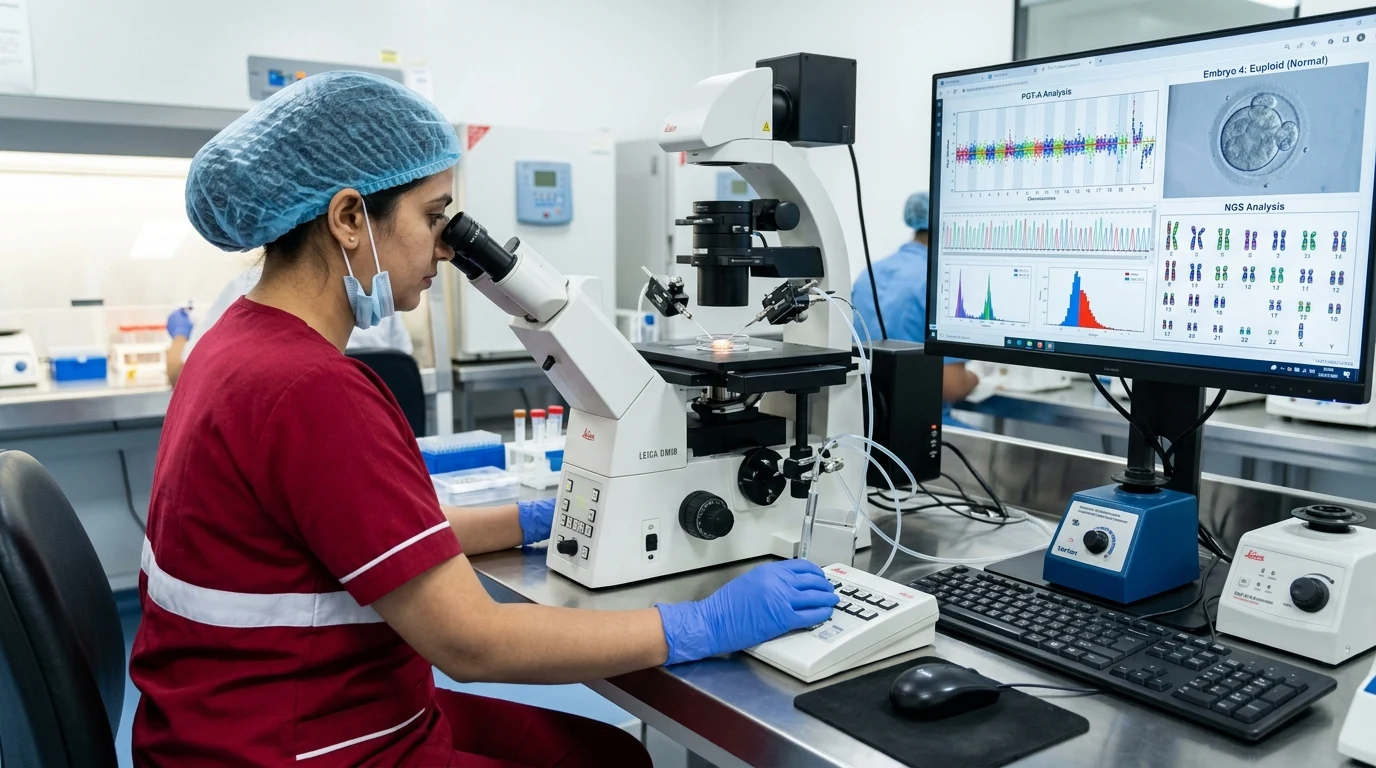


What You Need to Know (30-Second Summary)
- Diagnostic Filter: PGT-A screens 23 chromosome pairs using Next-Generation Sequencing; it identifies euploid vs aneuploid embryos before transfer.
- Targeted Indications: Most valuable for women aged 35+, couples with recurrent implantation failure, and recurrent miscarriage histories.
- Trophectoderm Safety: Experienced embryologists biopsy 5–8 cells from the future placenta; the inner cell mass forming the baby remains untouched.
- Mosaicism Potential: Low-level mosaic embryos can self-correct during development and represent viable options when no euploid embryos exist.
- PCPNDT Compliance: Under Indian law, prenatal sex determination is strictly prohibited; PGT is used exclusively for serious genetic health conditions.
Transferring an embryo that looks flawless under a microscope does not guarantee pregnancy. Visual appearance cannot detect missing or extra chromosomes. That is the decisive insight behind PGT-A.
In conventional IVF, an embryologist examines developing embryos under an optical microscope on Day 5.
"PGT-A gives us the ability to transfer embryos we know are chromosomally normal. For patients over 35 or those with recurrent losses, this technology can dramatically reduce heartbreak and improve efficiency."
We assign grades based on appearance: 4AA, 5AA, 4AB.
Couples rejoice when they hear they have "top-grade" blastocysts.
Yet transfers repeatedly fail. Or positive tests end in heartbreaking early miscarriages.
Couples feel bewildered. They ask, "Doctor, if the embryo was grade 5AA, why did it fail. ".
The answer lies in the fundamental limitation of optical microscopy.
Morphological grading evaluates cellular architecture: cell symmetry, expansion, and cohesion.
It cannot see DNA.
A morphologically beautiful 5AA blastocyst can be missing Chromosome 21, or carry an extra Chromosome 16.
Visual grading cannot distinguish a genetically normal embryo from an embryo with fatal chromosomal errors.
Preimplantation Genetic Testing for Aneuploidy, or PGT-A, bridges this diagnostic divide.
It sequences the embryonic chromosomes before transfer. This ensures that only genetically competent embryos enter the womb.
What Is Aneuploidy?
Human cells carry forty-six chromosomes in twenty-three pairs. There are twenty-two autosomal pairs and one pair of sex chromosomes.
An embryo with the exact forty-six chromosomes is called Euploid.
An embryo with missing chromosomes (monosomy) or extra chromosomes (trisomy) is called Aneuploid.
Aneuploidy is the primary biological driver of human reproductive failure:.
Over seventy percent of all failed IVF embryo transfers stem from embryonic aneuploidy.
Over seventy percent of all first-trimester miscarriages are caused by chromosomal errors.
Congenital genetic conditions like Down syndrome (Trisomy 21), Edwards syndrome (Trisomy 18). Patau syndrome (Trisomy 13) stem directly from chromosomal aneuploidy.
When an aneuploid embryo enters the uterus, nature's quality control mechanism usually detects the error. Implantation halts, or early miscarriage occurs.
How PGT-A Is Performed in the Cleanroom
PGT-A requires extraordinary embryological skill and advanced cleanroom technology:.
Culturing Embryos to the Day 5 Blastocyst Stage.
We never biopsy embryos on Day 3. Biopsying an eight-cell Day-3 embryo removes one-eighth of the future baby's cellular mass. This can impair developmental potential.
Instead, we culture all embryos to Day 5 or Day 6 expanded blastocysts. This contain over one hundred cells.
Safe Trophectoderm Biopsy in the Cleanroom.
Blastocyst Anatomy: Inner Cell Mass vs. Trophectoderm
The inner cell mass forms the future baby and remains completely untouched during biopsy. The dense cluster of cells that will become the fetus.
The outer trophectoderm forms the future placenta, from which five to eight cells are carefully sampled. The outer ring of cells that will become the placenta and fetal membranes.
Under high-power inverted optics, our senior embryologist uses an ultra-fine laser to breach the outer shell.
We gently aspirate five to eight cells exclusively from the outer trophectoderm ring.
The inner cell mass that forms the baby is left completely untouched and pristine.
Ultra-Rapid Vitrification Following Biopsy.
Immediately following biopsy, the blastocyst is vitrified and safely stored in liquid nitrogen at minus 196 degrees Celsius.
Next-Generation Sequencing for Chromosomal Mapping.
The biopsied cellular sample is transferred to our specialized genetic sequencing laboratory.
We extract embryonic DNA and perform Whole Genome Amplification.
We analyze the DNA using Next-Generation Sequencing, or NGS.
NGS scans all twenty-four chromosomes simultaneously with greater than ninety-eight percent accuracy.
Decoding PGT-A Results for Euploid, Aneuploid, and Mosaic Embryos
Within two to three weeks, your comprehensive genetic report arrives.
Three Genetic Classifications of PGT-A Tested Embryos
Euploid embryos carry exactly forty-six balanced chromosomes and yield the highest live birth rates. Exactly forty-six normal chromosomes. These are fully cleared for single embryo transfer.
Aneuploid embryos carry missing or extra chromosomes that result in implantation failure or miscarriage. Carry lethal numerical chromosomal errors (such as Monosomy 7, Trisomy 16). These embryos cannot produce a viable baby and are not transferred. This prevents failed cycles and miscarriages.
Mosaic embryos possess a mixture of euploid and aneuploid cells, evaluated individually by our team. Contain a mixture of both euploid and aneuploid cells. Many mosaic embryos self-correct during growth. Depending on the mosaic percentage, they result in completely healthy live births. We provide comprehensive genetic counseling for all mosaic findings.
Clinical Indications for PGT-A
Clear Clinical Indications for PGT-A Genetic Testing
Advanced Maternal Age (Thirty-Five and Older): Aneuploidy rates climb exponentially with age: roughly thirty percent at thirty, fifty percent at thirty-seven, seventy percent at forty. Over eighty-five percent at forty-two. PGT-A finds the precious euploid embryos hidden among aneuploid cohorts.
Couples with recurrent implantation failure benefit by transferring only tested euploid embryos. When two or more top-grade blastocyst transfers have failed unexplained.
Couples experiencing recurrent pregnancy loss reduce miscarriage rates to single digits with PGT-A. When a couple has suffered two or more early miscarriages.
Men with severe oligozoospermia or high DFI benefit by screening embryos for paternal aneuploidy. Severe oligospermia or high sperm DNA fragmentation increases embryonic mitotic errors.
Couples with a previous trisomic conception gain peace of mind through definitive screening. Couples with a history of Down syndrome or other aneuploidies.
The Clinical Benefits of PGT-A
Why choose PGT-A?
Dramatically Higher Implantation Rates Transferring a genetically verified euploid embryo delivers implantation rates exceeding 65 to 70 percent, because chromosomal errors cause the vast majority of early implantation failures.
Transferring a euploid blastocyst elevates clinical pregnancy rates. Success reaches seventy percent per transfer, regardless of maternal age.
Substantially Lower Miscarriage Risks Because aneuploidy causes over seventy percent of early pregnancy losses, selecting a euploid blastocyst drops the miscarriage risk from thirty percent down to below eight percent.
Transferring a euploid embryo slashes first-trimester miscarriage rates from thirty percent down to under eight percent.
Confidence in Elective Single Embryo Transfer Knowing an embryo is chromosomally balanced gives doctors and couples total confidence in transferring one single blastocyst, eliminating the medical risks of twin gestations.
A euploid blastocyst has high implantation potential. We confidently transfer a single embryo. This eliminates multiple pregnancies while maintaining peak success.
Fourth, Reduced Time and Emotional Cost.
Couples avoid months of failed transfers, painful negative pregnancy tests, and traumatic miscarriages. You transfer only embryos that carry genuine life potential.
A Balanced Perspective
PGT-A cannot create normal embryos. It cannot fix an aneuploid embryo.
It is a diagnostic filter, not a therapeutic cure.
PGT-A acts as an invaluable compass. It directs us to the single embryo that will become your healthy child.
Test with precision. Transfer with confidence. Bring your baby home safely.
Understanding Low-Level Versus High-Level Mosaic Embryos.
One of the most complex findings on a modern PGT-A report is Chromosomal Mosaicism.
A mosaic embryo contains two or more genetically distinct cell populations: some cells are euploid with forty-six normal chromosomes. Meanwhile, other cells carry numerical aneuploidies.
Mosaicism occurs when an error in chromosomal separation happens after fertilization, during embryonic cleavage.
Next-Generation Sequencing quantifies the exact percentage of mosaic cells in the biopsied trophectoderm sample:.
Low-Level Mosaic Embryos (Under 50% Aneuploid Cells): Clinical studies show low-level mosaic embryos have remarkable self-correcting capabilities.
During blastocyst development, normal euploid cells divide faster and outgrow aneuploid cells.
Aneuploid cells are pushed to the outer placental rim or undergo apoptosis. Meanwhile, the inner fetal mass develops with completely normal euploid genetics.
Transferring low-level mosaic blastocysts yields clinical pregnancy rates of fifty percent. Normal, healthy babies are born.
High-Level Mosaic Embryos (Over 50% Aneuploid Cells): Carry lower implantation rates and higher miscarriage risks. Transferred only when zero euploid embryos exist, following specialized genetic counseling.
PGT-A Versus PGT-M and PGT-SR
It is important to understand that PGT-A is part of a larger genetic testing family:.
PGT-A for aneuploidy tests for random numerical chromosome errors like missing or extra chromosomes, making it ideal for maternal age screening, recurrent loss, and unexplained implantation failures.
PGT-M is utilized when parents carry specific single-gene hereditary disorders like Beta Thalassemia, Sickle Cell Anemia, or Spinal Muscular Atrophy.
We design a customized genetic probe for that exact family mutation. We test the embryos thoroughly. We transfer only embryos free of the genetic disorder. This ends generations of hereditary illness.
PGT-SR for structural rearrangements is specifically designed for couples with parental balanced chromosomal translocations or inversions, screening embryos for unbalanced duplications.
Financial and Emotional Considerations
While PGT-A adds upfront laboratory costs, it frequently saves couples immense emotional and financial distress:.
It prevents the financial and physical cost of transferring embryos that are biologically doomed to fail.
It protects women from the heartbreak and physical trauma of first-trimester miscarriages and surgical curettages.
It reduces the total time required to achieve a healthy live birth, bringing your baby home faster.
Protecting Embryonic Viability During Cleanroom Biopsy
Many couples ask whether will taking cells for genetic testing damage my future baby.
The answer is a resounding no. The biopsy is performed with extreme precision under an inverted microscope.
We biopsy the embryo strictly at the blastocyst stage, on Day 5 or Day 6 of development.
At this stage, the embryo has differentiated into two distinct cellular parts:.
The inner cell mass. This will develop into the baby.
The outer trophectoderm. This will form the placenta and amniotic sac.
Our embryologist uses a non-contact infrared laser to gently separate five to six cells from the outer trophectoderm only.
The inner cell mass is never touched.
The biopsied cells are sent for genetic sequencing. Meanwhile, the blastocyst is immediately vitrified and preserved safely in liquid nitrogen.
Clinical studies spanning thousands of children show zero increase in congenital anomalies. Children develop normally.
PGT-A safeguards your child without harming embryonic potential.
Legal and Ethical Boundaries of Genetic Screening
In India, embryo testing is strictly regulated under the ART Act and PCPNDT Act.
PGT is strictly permitted for detecting chromosomal aneuploidies and preventing severe hereditary genetic disorders.
It cannot and will never be used for sex selection.
At Gunjan IVF World, we maintain absolute adherence to all national reproductive regulations.
Our genetic screening serves one pure purpose. It ensures your transferred embryo gives you the best chance of delivering a healthy baby.
PGT-A is modern precision medicine applied to reproduction.
Sequence with care. Transfer with total confidence. Let science protect your family's future.
📚 Recommended Clinical Guides
Frequently Asked Questions About PGT-A Genetic Testing in IVF: Benefits, Accuracy, and Who Needs It
Does embryo biopsy damage the developing baby?
No. Experienced embryologists biopsy only five to eight cells from the outer trophectoderm, which becomes the future placenta. The inner cell mass that develops into the baby remains untouched.
Can PGT-A guarantee a one hundred percent successful pregnancy?
No. PGT-A confirms chromosomal normalcy, boosting per-transfer pregnancy rates to sixty-five percent. However, successful implantation also depends on uterine receptivity, blood flow, and precise hormone timing.
Can PGT test for gender or physical traits?
Indian laws strictly prohibit prenatal sex determination with severe criminal penalties. PGT is used solely for fatal genetic disorders. PGT is used exclusively for detecting fatal aneuploidies and serious genetic disorders.
What happens if all our embryos test abnormal?
If an entire cohort tests aneuploid, transferring those embryos would have resulted in failed cycles or early miscarriages. Aneuploidy reflects egg age, and your doctor discusses adjusting stimulation protocols or exploring donor gametes.
Is PGT-A necessary for young couples doing IVF?
In women under thirty-five with strong egg reserve, over sixty percent of blastocysts are naturally euploid. Routine PGT-A is usually unnecessary unless there is a history of recurrent miscarriage or severe male factor.
Does embryo biopsy damage the blastocyst or cause birth defects?
No. Biopsying five trophectoderm cells leaves the inner fetal mass untouched. Millions of clinical transfers worldwide confirm that babies born from biopsied embryos have identical health and developmental outcomes as standard IVF babies.
Does PGT-A guarantee a live birth from a single transfer?
While PGT-A confirms chromosomal normality, successful pregnancy also requires an unobstructed, receptive uterine lining and proper hormonal support. A euploid blastocyst carries an outstanding sixty to seventy percent live birth rate.
Who benefits most from adding PGT-A to their IVF cycle?
PGT-A benefits women aged thirty-five or older and couples facing recurrent transfer failures. It also assists men with severe DNA fragmentation.
Can PGT-A test for single-gene disorders like cystic fibrosis or sickle cell anemia?
PGT-A tests exclusively for whole chromosome number errors (aneuploidies like Down syndrome). Testing for single-gene disorders requires PGT-M. PGT-M uses custom molecular probes designed specifically for that family genetic mutation.
The Path Forward: Taking Your Next Step with Confidence
Preimplantation Genetic Testing for Aneuploidy (PGT-A) provides valuable genetic insight into embryo chromosomal health before transfer. By biopsying a small number of trophectoderm cells from a Day 5 or Day 6 blastocyst, PGT-A identifies euploid (chromosomally balanced) embryos, reducing miscarriage rates, avoiding failed transfers, and shortening the overall time needed to achieve a healthy live birth.
PGT-A is especially valuable for women over 35, couples with recurrent implantation failure or recurrent miscarriage, and those with severe male factor infertility. Knowing the genetic status of your blastocysts allows your clinical team to transfer a single euploid embryo with high confidence, preventing the obstetric risks associated with multiple pregnancies.
Our advanced genetics and embryology team at Gunjan IVF World works with accredited genomic laboratories to provide precise Next-Generation Sequencing (NGS) analysis. Consult Dr. Gunjan Gupta Govil at our centres in Indirapuram, Noida Sector 49, Janakpuri, Greater Noida West, or Meerut to determine whether PGT-A is appropriate for your treatment.