


What You Need to Know (30-Second Summary)
- Cellular Time Freeze: Vitrification cools eggs at -20,000°C per minute, turning cellular water into glass without forming destructive ice crystals.
- The Numbers That Matter: Freezing 12–15 mature (MII) eggs before age 35 delivers an 80%+ cumulative live birth probability when thawed years later.
- Menopause Reserve Untouched: Stimulation rescues eggs destined for natural monthly atresia (cell death); your lifetime ovarian reserve remains intact.
- Statutory Age Limit: Under Section 21(g) of the Indian ART Act 2021, frozen eggs can be thawed and transferred anytime up to the age limit of 50 years.
- Simple Day-Care Procedure: Egg retrieval takes 15 minutes under light intravenous sedation with zero surgical incisions, stitches, or abdominal scars.
Freezing ten eggs at thirty-one gives you a vastly better pregnancy chance than freezing twenty eggs at thirty-nine.
When you freeze your eggs, you are not pausing your body's biological clock. You are locking a specific cohort of single cells in liquid nitrogen at their exact current cellular age.
"Egg freezing is one of the most empowering decisions a woman can make for her future fertility. It is not about delaying — it is about preserving your options while biology is on your side."
Eggs do not age once frozen. But your ovaries keep aging every single month before you freeze them. Biology is stubborn. Ovaries keep time.
When women sit across from me in our Indirapuram clinic asking about egg freezing, I do not offer corporate empowerment slogans. I open their ultrasound scan and look at their antral follicle count.
Don't guess. Never assume. Check your numbers first.
Egg freezing is an advanced cryobiological procedure. It is essentially the first half of a complete IVF cycle, stopping right before sperm meets egg.
The Technical Biology of Cryopreserving Oocytes
Human eggs are uniquely fragile cells. Extremely delicate.
An unfertilised egg is the largest single cell in the human body. It contains a high percentage of water and holds all its genetic material balanced on a delicate spindle apparatus.
In the 1990s, clinics used slow-cooling techniques. As temperatures dropped slowly, water inside the egg formed jagged microscopic ice crystals. These ice crystals fractured the internal cell architecture and shredded the chromosomes. Most eggs died upon thawing.
Everything changed with vitrification. Science leaped forward.
Vitrification is ultra-rapid flash freezing. We dehydrate the egg using specialized cryoprotectant solutions and plunge it directly into liquid nitrogen at minus 196 degrees Celsius.
The cooling happens at over twenty thousand degrees per minute.
At that speed, water cannot arrange itself into ice crystals. Instead, the fluid instantly hardens into a smooth, glass-like solid state. Zero ice. Pure glass. The survival rate of mature eggs thawed after vitrification now exceeds ninety percent in skilled cleanrooms.
What Happens During Your Stimulation and Retrieval
The medical process takes roughly twelve to fourteen days from the start of your menstrual cycle.
Ovarian Stimulation
Normally, your body recruits a group of follicles each month. However, only one ovulates while the rest dissolve naturally. We give you daily subcutaneous gonadotropin injections for nine to eleven days. These injections rescue those follicles that would otherwise waste away. This allows multiple eggs to mature together. You do not deplete your future egg reserves. You simply harvest eggs that were already destined to disappear that month.
Follicular Tracking
You visit our clinic three or four times for transvaginal ultrasound monitoring and serum estradiol blood checks. We measure the exact diameter of every growing follicle. When your lead follicles reach seventeen to nineteen millimetres, we trigger final cellular maturation. We use a GnRH agonist trigger rather than hCG. This triggers egg release while dropping your risk of ovarian hyperstimulation to nearly zero.
Daycare Egg Retrieval
Thirty-six hours after your trigger shot, you come to our daycare theatre. You sleep comfortably under light intravenous sedation for fifteen minutes. Our specialist guides a thin aspiration needle through the vaginal wall into each follicle under direct ultrasound imaging. There are no incisions, no abdominal cuts, and no stitches. You wake up ten minutes later and return home after a short rest.
Cleanroom Denudation and Vitrification
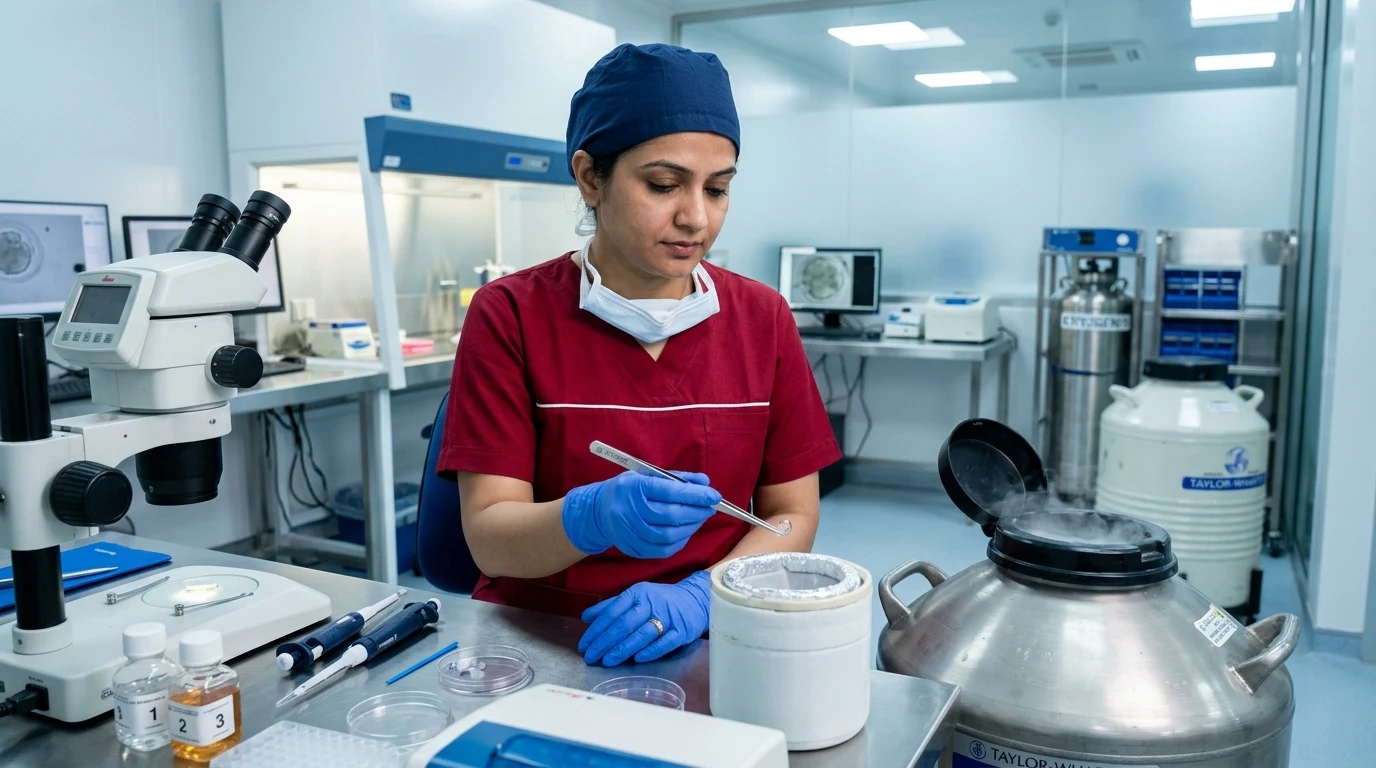
Inside our embryology cleanroom, our embryologist strips away the surrounding cumulus cells using an enzyme called hyaluronidase. We examine each egg under high magnification. Only fully mature Metaphase II eggs can be frozen. Immature eggs cannot be fertilised later. Our embryologist loads your mature eggs onto microscopic cryo-straws and plunges them into liquid nitrogen tanks. Cold, quiet, and secure. Liquid nitrogen protects them.
The Biological Reality of How Many Eggs You Need
Egg freezing is not an insurance policy with a guaranteed payout. It is a game of cellular probabilities.
Not every follicle contains an egg. Not every egg collected is mature. Not every mature egg survives thawing years later. Not every thawed egg fertilises with sperm. Not every fertilised egg reaches the robust Day-5 blastocyst stage.
Age determines egg genetics. Mother Nature is strict.
If you freeze eggs at thirty, roughly seventy percent of your eggs are chromosomally intact. A cohort of twelve to fifteen mature eggs delivers an eighty percent live birth probability. Solid odds.
If you freeze eggs at thirty-eight, more than half of your remaining eggs carry natural chromosomal errors. You might need twenty to twenty-five eggs to achieve that same statistical safety net. That often requires two or three separate retrieval cycles.
Timing matters. Freezing before thirty-five yields the highest return on your investment. Plan early.
What Happens Years Later When You Want a Baby?
When you decide the time is right to build your family, you notify our clinic.
We thaw your eggs in our cleanroom. Because vitrification hardens the outer protein shell of the egg, conventional IVF fertilisation will not work.
We perform Intracytoplasmic Sperm Injection. Here, our embryologist injects one healthy, selected sperm directly through the hardened shell into the egg cytoplasm.
Your partner provides a semen sample, or we prepare donor sperm from a certified bank. We culture the resulting embryos for five full days until they become blastocysts. Our specialist transfers one healthy blastocyst into your prepared uterine lining. Under the Indian ART Act 2021, embryo transfer can take place anytime up to the statutory age limit of fifty years. Any remaining blastocysts are safely refrozen.
Legal Framework and Statutory Storage Limits in India
Egg freezing in India is governed by the landmark Assisted Reproductive Technology (Regulation) Act, 2021.
The law establishes clear legal protections and ethical boundaries for women choosing elective or medical cryopreservation.
Under Section 21(g), frozen eggs can be stored in registered banks and transferred up to age fifty.
This generous timeline provides women with complete autonomy over their career, education, and personal family timing.
The law mandates that all gametes be stored in licensed National ART Banks adhering to strict cryo-storage standards.
Liquid nitrogen levels, tank vacuum integrity, and temperature monitoring systems are maintained with dual fail-safe alarms.
You retain sole legal ownership and decision-making power over your vitrified oocytes.
They cannot be accessed, moved, or utilized without your written notarized consent.
Long-Term Cryopreservation Safety and Health of Children
A common question among women exploring elective egg freezing is whether liquid nitrogen storage degrades cellular vitality over time.
Vitrification plunges oocytes into liquid nitrogen at minus one hundred and ninety-six degrees Celsius within milliseconds.
At this cryogenic temperature, all molecular and biological metabolic activity ceases completely.
An egg frozen for five years remains biologically identical to an egg frozen for five months.
Global registry data confirms frozen eggs carry no increase in birth defects. Children demonstrate normal developmental milestones.
Children born from frozen eggs demonstrate identical health and cognitive growth milestones compared to naturally conceived peers.
Evidence-Based Strategies and Clinical Inquiries
Does egg freezing cause early menopause?
No. Every month, your ovaries naturally recruit dozens of immature follicles. However, your body only selects one for ovulation. The rest undergo natural cell death and disappear. Stimulation injections simply provide the hormonal support to mature that existing cohort. You are using eggs that would have been discarded naturally that month. Your lifetime reserve remains completely untouched. Safe and sound.
How long can frozen eggs safely remain in storage?
Human eggs frozen via vitrification can stay in liquid nitrogen indefinitely without cellular biological degradation. Successful pregnancies have occurred from eggs frozen for well over ten years. Under the Indian ART Act 2021, storage timelines are clearly documented. Registered ART banks guarantee compliance and security.
Is the egg retrieval procedure painful?
The procedure is performed under short intravenous sedation. This means you are asleep and feel absolutely nothing during the collection. Afterward, you might experience mild pelvic fullness or slight menstrual cramping for twenty-four hours. Simple paracetamol manages any discomfort. Most women return to work the very next day.
What if I never need to use my frozen eggs?
If you conceive naturally later in life and do not need your frozen eggs, you maintain complete legal control over their disposition. You can instruct the clinic to discard them ethically. Alternatively, donate them to licensed scientific research with written consent. The choice remains entirely yours. Always.
Does freezing my eggs deplete my natural ovarian reserve faster?
No. An egg freezing cycle rescues monthly follicles. Otherwise, these resting eggs undergo natural cell death through atresia. It does not touch your future egg supply.
What is the ideal age window for social egg freezing?
The optimal freezing window is between age twenty-seven and thirty-five. Both egg quantity and chromosomal vitality remain high.
How Many Eggs to Freeze for High Success Odds
A critical question every woman asks is, "How many eggs do I need to freeze to be safe. ".
Because human reproduction involves natural attrition, freezing more eggs creates a stronger safety net.
Audited statistical models show clear benchmarks based on female age at the time of freezing:.
For women under thirty-five, vitrifying twelve to fifteen mature eggs provides an eighty to eighty-five percent cumulative chance of a live birth. Freezing twelve to fifteen mature Metaphase II (MII) eggs provides an eighty to eighty-five percent cumulative probability of at least one live birth.
Women Aged Thirty-Five to Thirty-Seven: Freezing fifteen to twenty mature eggs is recommended to achieve an equivalent seventy-five to eighty percent probability.
For women aged thirty-eight to forty, freezing twenty to twenty-five eggs is advised to compensate for chromosomal attrition. Freezing twenty to twenty-five eggs is advised. This typically requires two gentle retrieval cycles.
Freezing early provides the highest biological efficiency. Your eggs remain frozen at your current biological age indefinitely.
The Step-by-Step Thawing and Fertilization Process
When you are ready to build your family years later, the process of using your frozen eggs is efficient and gentle:.
The vitrified eggs are warmed in our laboratory, undergoing rapid rehydration within minutes.
Over ninety percent of vitrified eggs survive thawing completely intact.
Our embryologist fertilises each egg using Intracytoplasmic Sperm Injection (ICSI), introducing your partner's or donor sperm directly into the ooplasm.
Fertilised eggs are cultured in benchtop incubators for five days until they reach the blastocyst stage.
Meanwhile, your uterus is prepared with estrogen and progesterone to create a plush endometrial lining.
A single thawed blastocyst is placed painlessly into your uterus. You return home immediately.
📚 Recommended Clinical Guides
Frequently Asked Questions About Egg Freezing: What It Is, How It Works, and What Success Looks Like
Does egg freezing cause early menopause?
No. Every month, your ovaries naturally recruit dozens of immature follicles, but your body only selects one for ovulation. The rest undergo natural cell death and disappear. Stimulation injections simply provide the hormonal support to mature that existing cohort. You are using eggs that would have been discarded naturally that month. Your lifetime reserve remains completely untouched. Safe and sound.
How long can frozen eggs safely remain in storage?
Human eggs frozen via vitrification can stay in liquid nitrogen indefinitely without cellular biological degradation. Successful pregnancies have occurred from eggs frozen for well over ten years. Under the Indian ART Act 2021, storage timelines are clearly documented. Registered ART banks guarantee compliance and security.
Is the egg retrieval procedure painful?
The procedure is performed under short intravenous sedation, meaning you are asleep and feel absolutely nothing during the collection. Afterward, you might experience mild pelvic fullness or slight menstrual cramping for twenty-four hours. Simple paracetamol manages any discomfort. Most women return to work the very next day.
What if I never need to use my frozen eggs?
If you conceive naturally later in life and do not need your frozen eggs, you maintain complete legal control over their disposition. You can instruct the clinic to discard them ethically. Alternatively, donate them to licensed scientific research with written consent. The choice remains entirely yours. Always.
Does freezing my eggs deplete my natural ovarian reserve faster?
No. An egg freezing cycle rescues monthly follicles. Otherwise, these resting eggs undergo natural cell death through atresia. It does not touch your future egg supply.
What is the ideal age window for social egg freezing?
The optimal freezing window is between age twenty-seven and thirty-five. Both egg quantity and chromosomal vitality remain high.
The Path Forward: Taking Your Next Step with Confidence
Elective and medical egg freezing allows you to preserve your current biological fertility potential for the future. Because egg quality and chromosomal normality are tied to age at the time of retrieval, freezing mature oocytes before age 35 provides the highest statistical probability of a future live birth per thawed egg.
Taking action begins with an objective assessment of your current ovarian reserve. A simple blood test for Anti-Müllerian Hormone (AMH) combined with a transvaginal ultrasound to measure your Antral Follicle Count (AFC) establishes your expected mature egg yield per stimulation cycle, helping you plan whether one or two cycles are recommended to reach your target number of 15 to 20 vitrified eggs.
At Gunjan IVF World, our embryology team uses Cryotop vitrification technology to achieve post-thaw survival rates exceeding 95%. Consult Dr. Gunjan Gupta Govil and our fertility specialists at our centres in Indirapuram, Noida Sector 49, Janakpuri, Greater Noida West, or Meerut to plan your egg freezing cycle.