

What You Need to Know (30-Second Summary)
- Double-Check First: Always confirm zero sperm with a repeat semen analysis and centrifuged pellet check before planning surgical procedures.
- Two Distinct Types: Obstructive azoospermia (transport plumbing block) vs Non-obstructive azoospermia (testicular factory slowdown).
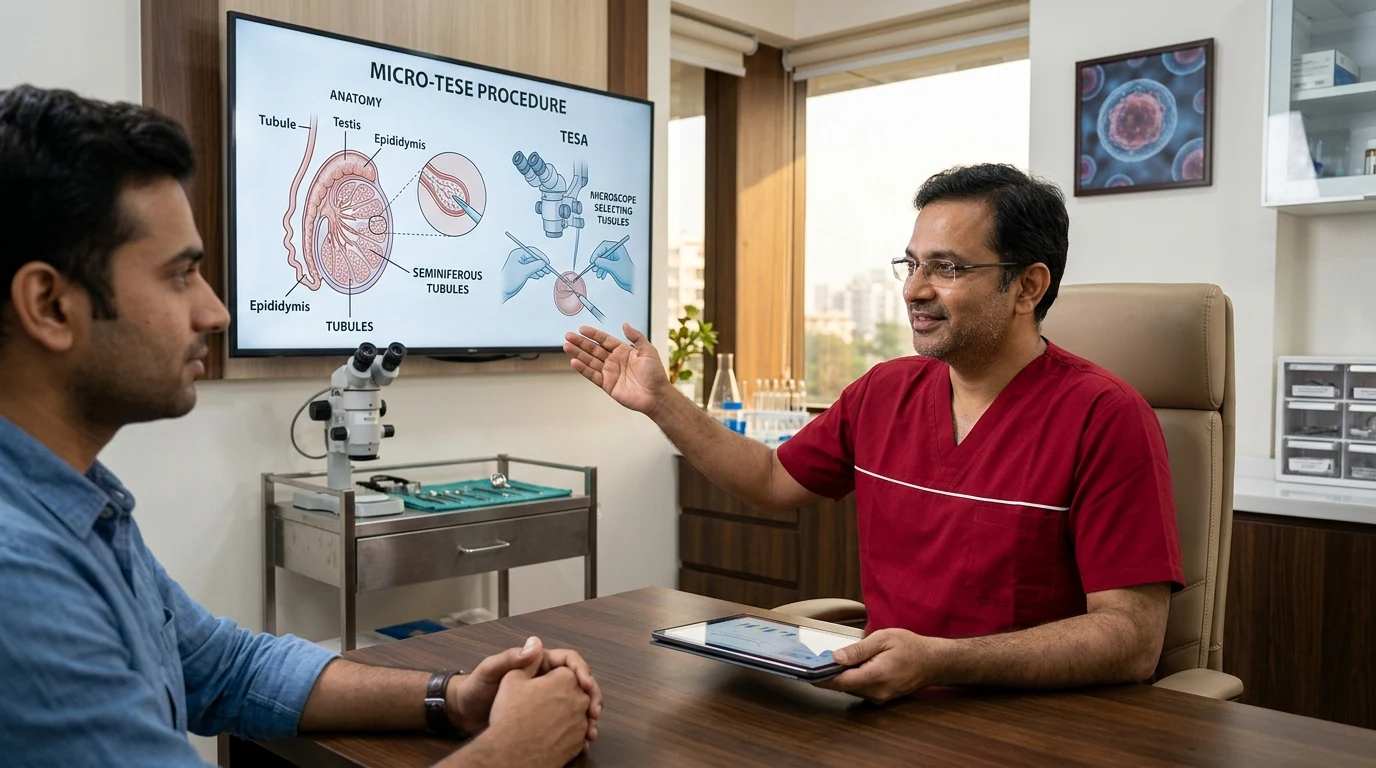
- Targeted Retrieval: PESA collects stored sperm from the epididymis; TESA and Micro-TESE collect sperm directly from productive testicular tubules.
- The Cooked Rice Grain Reality: Under high-power operating microscopes (15–20x), plump opaque tubules containing living sperm are isolated from empty grey tubules.
- ICSI Integration: Surgically retrieved sperm cannot fertilise an egg naturally; they are injected directly into mature eggs via ICSI to create Day-5 blastocysts.
Zero sperm sounds terrifying. Men freeze in shock. But azoospermia is not the end. Not at all.
Azoospermia affects roughly one percent of all adult men. Ten to fifteen percent of men seeking fertility care.
"A zero sperm count diagnosis is not the end of the fatherhood dream. Surgical sperm retrieval techniques like Micro-TESE can find viable sperm in over 50% of men with non-obstructive azoospermia."
When the laboratory technician writes "No spermatozoa seen in ejaculate, even after centrifugation", panic sets in.
Men believe their dream of biological fatherhood has ended. They assume donor sperm is their only option.
In modern reproductive andrology, that assumption is false.
Azoospermia simply means zero sperm exit the urethra.
In the vast majority of azoospermic men, living, genetically competent sperm exist inside the reproductive tract.
Our job is to find those sperm. We retrieve them gently. We inject them into eggs. We build your family.
Distinguishing Obstructive From Non-Obstructive Azoospermia
The very first step in evaluating azoospermia is dividing it into two completely different biological conditions:.
Obstructive Azoospermia, or OA.
In obstructive azoospermia, the testicular factory operates at full capacity.
The testes manufacture millions of healthy, motile sperm every single day.
However, a physical barrier, stricture, or missing tube prevents sperm from entering the ejaculate.
It is like a factory with locked exit gates.
What causes obstruction. Previous vasectomy is common. Inguinal hernia scars can block the vas. Past epididymal infections cause scarring. In some men, transport tubes never formed.
In obstructive azoospermia, retrieval rates reach one hundred percent. Nearly every single man produces sperm.
Non-Obstructive Azoospermia, or NOA.
In non-obstructive azoospermia, the transport tubes are completely open and clear.
The challenge lies inside the testicular factory itself.
Due to genetic factors, childhood cryptorchidism, mumps orchitis, or previous chemotherapy, the testes produce very few sperm.
Production is severely depressed.
However, even in men with non-obstructive azoospermia, production is rarely zero across the entire organ.
In fifty percent of NOA men, sperm islands exist. They are hidden inside the tissue. Locating them is our surgical goal.
Locating those isolated pockets is the objective of advanced surgical retrieval.
How We Distinguish OA from NOA
We differentiate between obstructive and non-obstructive azoospermia through three non-invasive clinical tests:.
Testing Serum FSH Levels FSH is the master hormone driving sperm production. If FSH is normal in a man with zero sperm, the factory is usually working and a physical blockage is present.
FSH is our key marker. In obstructive cases, FSH is normal. In non-obstructive cases, FSH climbs high.
In obstructive azoospermia, the testes are healthy and functioning. Pituitary FSH levels are completely normal, typically between 2 and 8 mIU/mL.
In non-obstructive azoospermia, the brain senses that the testicular factory is struggling. The pituitary gland pumps out massive amounts of FSH to force production. FSH climbs above 12, 15, or 25 mIU/mL.
Assessing Testicular Volume Testicular size provides an immediate clinical clue. Adult testes typically measure fifteen to twenty-five millilitres. Small, soft testes under ten millilitres suggest primary production failure.
During physical examination, our andrologist measures testicular dimensions with an orchidometer.
In obstructive azoospermia, testes are firm and normal in size, measuring fifteen to twenty-five milliliters.
In non-obstructive azoospermia, testes are often soft, small, and atrophic, measuring under ten milliliters.
Analyzing Semen Biochemistry and pH We measure seminal fructose and pH. Semen should be alkaline with a pH above 7.2. Acidic semen devoid of fructose confirms obstruction or absence of the seminal vesicles.
Normal semen is alkaline, with a pH above 7.2, and contains fructose secreted by the seminal vesicles.
In congenital absence of the vas, semen volume is low. It measures under one milliliter. It is acidic. Fructose is absent. This confirms an anatomical blockage.
Surgical Sperm Retrieval Techniques
Depending on whether you have obstructive or non-obstructive azoospermia, we deploy specific surgical retrieval procedures:.
Percutaneous Epididymal Sperm Aspiration or PESA
PESA is our first-line procedure for obstructive azoospermia.
It is an elegant, minimally invasive daycare procedure performed under local anesthesia.
Our surgeon stabilizes the epididymis between two fingers.
A fine twenty-one-gauge butterfly needle attached to a syringe enters through the scrotal skin into the head of the epididymis.
Gentle suction aspirates clear epididymal fluid.
Our embryologist examines the fluid immediately under a microscope in the adjacent cleanroom.
PESA takes ten minutes. It yields millions of motile sperm. Zero incisions. Zero pain. You walk home before noon.
Zero skin incisions. Zero stitches. The patient walks home thirty minutes later.
Testicular Sperm Aspiration or TESA
TESA is used when PESA fails to yield sperm, or in men with previous epididymal scarring.
Under local anesthesia, a fine biopsy needle passes through the scrotal skin directly into the testicular tissue.
A small core of seminiferous tubules is aspirated.
The embryologist gently teases the tubules under the microscope to release mature testicular sperm.
TESA is quick, virtually painless, and leaves zero scars.
Micro-TESE for Non-Obstructive Azoospermia
In men with non-obstructive azoospermia, needle aspiration like TESA rarely works because sperm production is confined to tiny, scattered islands.
Blind needle pokes miss these microscopic pockets over eighty percent of the time.
The international gold standard for non-obstructive azoospermia is Microdissection TESE, or Micro-TESE.
Micro-TESE is an advanced microsurgical procedure performed under general anesthesia.
Our andrologist makes a small midline scrotal incision and opens the tunica albuginea of the testis.
We place an operating microscope directly over the surgical field, magnifying the testicular tissue twenty to twenty-five times.
Under high magnification, our surgeon meticulously inspects thousands of microscopic seminiferous tubules.
What are we looking for?
Tubules that lack sperm production appear thin, narrow, collapsed, and yellowish-white.
Tubules containing active sperm production are distinctly swollen, dilated, opaque, and grayish-pink, packed with dividing germ cells.
Our surgeon delicately excises only these dilated candidate tubules, sparing all surrounding blood vessels and normal tissue.
We hand the microscopic tissue fragments through the pass-through hatch directly to our embryologist.
The embryologist mechanically and enzymatically processes the tubules, searching for viable spermatozoa.
Micro-TESE transforms success rates. Retrieval jumps from twenty percent to over fifty-five percent. It finds hidden sperm islands.
Because Micro-TESE removes tiny amounts of tissue under direct vision, it dramatically lowers the risk of post-operative testicular vascular injury and testosterone collapse compared to conventional large biopsies.
Freezing Retrieved Sperm
Once sperm are retrieved, they are either injected immediately into the wife's freshly retrieved eggs via ICSI, or cryopreserved in liquid nitrogen.
Surgically retrieved testicular sperm can be frozen in ultra-fine vitrification straws for future use.
Freezing retrieved sperm beforehand removes psychological stress on egg retrieval morning and prevents the wife from undergoing stimulation if zero sperm are found.
Genetic Considerations
Before proceeding to Micro-TESE, every man with non-obstructive azoospermia must undergo genetic counseling:.
Karyotyping rules out Klinefelter syndrome.
Y-chromosome microdeletion testing checks for AZF deletions.
If a deletion in AZFa or AZFb is present, sperm retrieval is virtually impossible. Surgery is avoided.
If an AZFc deletion is present, sperm retrieval rates remain high (around fifty percent). However, any male offspring will inherit the exact same AZFc deletion. Couples receive complete genetic transparency.
A Realistic and Hopeful Future
Hearing an azoospermia diagnosis is difficult, but it is not the end of your family dream.
With precise differentiation between obstruction and non-obstruction, minimally invasive PESA/TESA. State-of-the-art Micro-TESE, over seventy percent of azoospermic couples achieve biological fatherhood.
Consult an expert reproductive andrologist. Protect your testicular tissue. Let science unlock your fertility.
Laboratory Processing of Micro-TESE Tissue Fragments
The success of a Micro-TESE procedure depends as much on the embryologist's laboratory expertise as on the surgeon's hands.
When our surgeon excises swollen, opaque seminiferous tubules under the operating microscope, they are passed immediately through the cleanroom hatch.
Inside the embryology laboratory, the tissue undergoes rigorous processing:.
Our embryologist places biopsied tissue in specialized culture dishes and teases tubules apart with fine needles. The embryologist places the tubules into a petri dish containing buffered culture media. Using fine twenty-six-gauge sterile needles or microscopic glass slides, the embryologist mechanically shreds and minces the tubules, teasing apart the basement membranes to release trapped spermatozoa.
We apply erythrocyte lysis buffers to dissolve red blood cells that obscure hidden sperm. Testicular biopsies often contain microscopic blood that obscures visualization. We treat the cell suspension with erythrocyte-lysing buffer to remove red blood cells while preserving fragile spermatozoa.
In challenging fibrous biopsies, gentle collagenase enzymes dissolve tough tissue bands safely. In fibrotic or challenging biopsies, we incubate the tissue fragments with collagenase and hyaluronidase enzymes for thirty minutes. These enzymes digest dense connective tissue matrices, freeing viable sperm.
Serial Centrifugation and Extended Microscopic Search: The suspension is centrifuged to concentrate cells into a micro-pellet. Our senior embryologist spends two, three, or four hours meticulously scanning micro-droplets under 400x inverted optics.
Finding even ten or fifteen viable sperm is a complete clinical triumph.
Those retrieved sperm are immediately used for ICSI or vitrified in ultra-fine carriers for future cycles.
Testicular Fine Needle Aspiration Mapping
In complex cases of non-obstructive azoospermia, Testicular Fine Needle Aspiration, or TESA mapping, provides a non-invasive diagnostic preview.
Under local anesthesia, our andrologist uses a fine needle to sample multiple geographic sites across the testis: upper pole, mid pole. Lower pole.
Cytological evaluation creates an anatomical map of where sperm production is active.
If mapping identifies focal areas of spermatogenesis, it provides an exact GPS roadmap for the subsequent Micro-TESE procedure, directing the surgeon straight to the productive zones while sparing inactive areas.
Post-Operative Testosterone Monitoring
A vital clinical responsibility after any testicular surgery is monitoring endocrine health.
The testes contain Leydig cells that produce ninety-five percent of circulating male testosterone.
Aggressive, outdated open testicular biopsies frequently damaged testicular blood supplies. This leads to permanent Leydig cell atrophy and lifelong hypogonadism.
Because Micro-TESE is performed under high-power optical magnification, our surgeon delicately preserves every testicular arterial branch and microvascular arc.
We retest morning serum testosterone at three months, six months, and twelve months post-surgery.
Clinical studies confirm that over ninety percent of men maintain completely normal baseline testosterone levels after Micro-TESE.
Azoospermia requires specialized, dedicated expertise.
With expert microsurgery and tireless embryology searching, biological fatherhood is a realistic, achievable reality.
📚 Recommended Clinical Guides
Frequently Asked Questions About Azoospermia: Causes, Types, and Surgical Sperm Retrieval (TESA/PESA/Micro-TESE)
Does Micro-TESE hurt and when can I return to work?
You are sound asleep under anaesthesia throughout the operation. You feel zero pain. Afterwards, your scrotum aches like a sports injury. A simple painkiller and a tight scrotal support jockstrap keep you comfortable. Rest over the weekend. You can return to desk work on Monday morning.
Can men with Klinefelter syndrome father biological children?
Yes. Men with 47,XXY chromosomes usually have zero sperm in their ejaculate. Yet hidden pockets of sperm production exist in nearly half of them. Micro-TESE finds living sperm in forty to fifty percent of Klinefelter men, giving them biological children.
Will testicular surgery destroy my natural testosterone?
No. An experienced microsurgeon operates under twenty-five times magnification, carefully avoiding Leydig cells and delicate blood vessels. You might see a mild dip in blood testosterone for a month. Your body bounces back to normal baseline within three to six months.
What is the difference between PESA and TESA?
Think of the anatomy. PESA taps the storage garage behind the testicle. TESA taps the factory floor inside the testicle itself. We use PESA first whenever the storage garage has fluid. If the garage is scarred or empty, we move to TESA.
Can we freeze sperm retrieved through Micro-TESE?
Yes. Freezing is mandatory. We never want a man undergoing repeated testicular operations. When we find viable sperm during Micro-TESE, our cleanroom freezes them into micro-straws in liquid nitrogen. We verify sperm are safe in storage before your wife ever starts her daily injection pens.
The Path Forward: Taking Your Next Step with Confidence
Receiving a semen analysis report showing zero sperm (azoospermia) is distressing, but it does not mean biological fatherhood is impossible. Modern reproductive medicine clearly differentiates between obstructive azoospermia (where normal sperm production occurs behind a physical blockage) and non-obstructive azoospermia (where testicular production is impaired), offering targeted surgical solutions for each.
A comprehensive andrological evaluation—including serum FSH, LH, total testosterone, karyotype testing, Y-chromosome microdeletion screening, and scrotal ultrasound—identifies whether needle aspiration (PESA/TESA) or advanced microscopic testicular sperm extraction (Micro-TESE) is indicated. Even in non-obstructive cases, micro-TESE identifies isolated pockets of active spermatogenesis in up to 50% of men, yielding viable sperm for ICSI.
Dr. Gunjan Gupta Govil and our specialized andrology microsurgeons at Gunjan IVF World provide cutting-edge surgical sperm retrieval. Visit our centres in Indirapuram Ghaziabad, Janakpuri West Delhi, Noida Sector 49, Greater Noida West, or Meerut to discuss your treatment options with our andrology team.