

Pelvic tuberculosis or infection can scar fallopian tubes shut. When both tubes are blocked, natural conception odds in bed drop to zero percent. You cannot force an egg through scar tissue.
What You Need to Know (30-Second Summary)
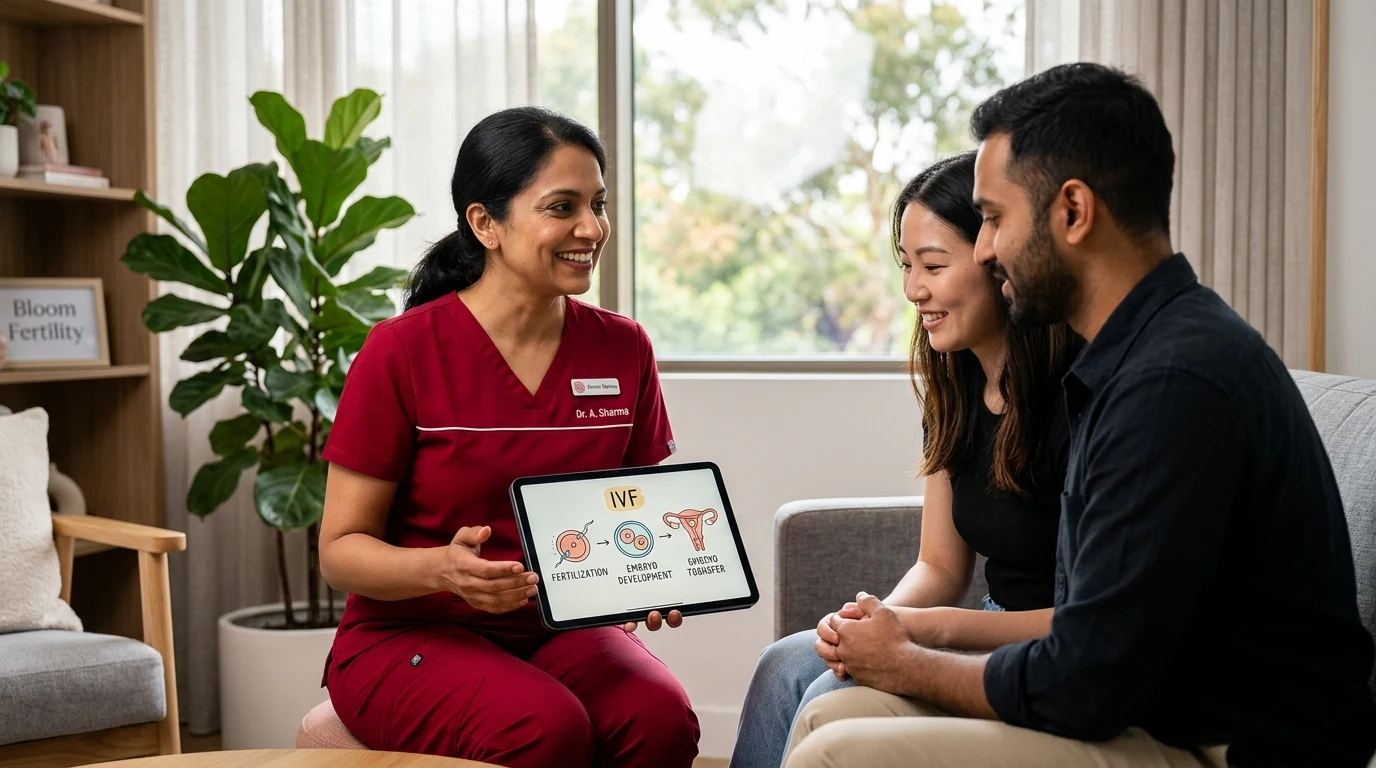
- The Basics: IVF helps couples conceive by fertilising an egg with sperm in a laboratory, bypassing the fallopian tubes.
- The Patient Journey: Involves ovarian stimulation, egg retrieval, laboratory fertilisation, and embryo transfer.
- Who It Helps: Effective for tubal blockages, endometriosis, severe male factor, or unexplained infertility.
- Safety First: Modern protocols at Gunjan IVF World minimize risks like OHSS and multiple pregnancies through customized care.
- Support System: Your dedicated clinical team provides counseling and step-by-step guidance throughout the entire process.
Yet moving those exact same eggs into a cleanroom incubator changes everything. Your pregnancy odds immediately leap past sixty-five percent.
"In Vitro Fertilisation is not an artificial creation of life. It is simply a safe mechanical bypass around blocked fallopian tubes or compromised sperm, giving your own biological cells the ideal environment to meet."
In Vitro Fertilisation is not an experimental gamble. It is a mechanical bypass.
When the natural bridge inside your body is broken or absent, IVF simply relocates that meeting to a medical cleanroom.
Throw away the forum printouts. Stop reading midnight horror stories.
Most patients arrive at my Indirapuram clinic terrified of three things. They think IVF creates synthetic babies with genetic defects. They expect horrific pain during egg retrieval. They fear hormone injections will exhaust their remaining lifetime egg supply.
None of that is true. Not one bit.
A natural conception requires four working pieces. You need a mature egg, energetic sperm, open tubes for them to meet, and a healthy uterine lining.
If any single piece fails, natural conception stalls completely. Years pass. Nothing happens.
What an IVF Cycle Actually Does
In nature, your ovary recruits ten or fifteen resting follicles every month. Your pituitary gland releases just enough FSH to mature a single lead egg. The rest of that monthly cohort starves, dies, and dissolves inside the ovary. Gone forever.
IVF stimulation does not rob your future menopause reserve. It does the exact opposite. Daily gonadotropin injections rescue that doomed monthly cohort. We provide enough hormone support to nourish eight, ten, or twelve eggs together. You are only using the eggs nature already marked for disposal that month.
Daily injections take two minutes each evening. You use tiny micro-needles identical to insulin pens. No thick intramuscular needles in your hips. No bruising. You barely feel the pinch.
Between days eight and twelve, we monitor follicle growth on ultrasound. We check your blood estradiol levels. We want lead follicles measuring seventeen to twenty millimetres.
When the follicles are mature, we administer your trigger injection. Timing must be exact to the hour.
Thirty-six hours later, you walk into our daycare theatre.
You sleep comfortably for fifteen minutes under gentle intravenous sedation. Our anaesthesiologist stays at your head the entire time. Our fertility specialist guides a fine ultrasound aspiration needle through the vaginal wall directly into each ovarian follicle. A gentle pump draws the fluid into pre-warmed sterile tubes.
No surgical cuts. No abdominal scars. No stitches. Zero.
You wake up in our recovery ward twenty minutes later. You might feel a dull menstrual ache in your pelvis. A simple oral tablet settles it. You drink a cup of warm tea, change your clothes, and walk home within two hours.
Inside the Cleanroom Laboratory
The moment follicular fluid leaves your body, it passes through a heated hatch into our embryology cleanroom.
Our embryologists examine the fluid under forty-times magnification to isolate every mature egg.
Your partner provides a fresh semen sample. Our lab washes away seminal fluid, bacteria, and dead cells. We isolate only the fastest, morphologically pristine sperm.
If semen numbers are strong, we perform conventional IVF. We place fifty thousand washed sperm around each egg in a culture droplet inside a benchtop incubator.
If your partner has low count, poor swimming speed, or high DNA fragmentation, standard mixing fails. We switch to Intracytoplasmic Sperm Injection. Our embryologist immobilises one prime swimming sperm. They inject it directly into the egg using a microscopic glass pipette. That single microscopic step erases years of male factor barriers.
Eighteen hours later, we check for two pronuclei. That confirms fertilisation. Life has begun.
Why Day 5 Blastocysts Change Everything
In the 1990s, clinics transferred embryos on Day 2 or Day 3. That was a guessing game.
A Day 3 embryo contains only six to eight cells. Genetically flawed embryos frequently look perfect on Day 3. Then their internal cellular energy runs out, and they arrest forty-eight hours later.
We culture every embryo for five full days until it expands into a blastocyst containing over one hundred cells.
Day 5 blastocyst culture acts as a ruthless biological filter. Only embryos with intact chromosomes and robust cellular stamina can reach the blastocyst stage. Culturing to Day 5 allows us to pick the single strongest embryo with the highest implantation odds.
One embryo is enough. We transfer one high-grade blastocyst into your uterus. That protects you from the medical dangers of twins or triplets while delivering high pregnancy success.
If you have extra blastocysts, we freeze them using rapid vitrification at minus 196 degrees Celsius in liquid nitrogen. They remain suspended in time, unaffected by your biological clock.
The Five-Minute Transfer and the Two-Week Wait
Embryo transfer is the easiest step of the entire medical cycle.
No anaesthesia. No sedation. No pain.
You arrive with a comfortably full bladder. The fluid in your bladder creates an acoustic window on the ultrasound, flattening your uterus. Our doctor guides a soft, flexible catheter through the cervix and deposits your blastocyst one centimetre below the uterine fundus.
You watch the transfer live on our overhead screen. A tiny white flash of air marks the exact landing spot. Our embryologist inspects the catheter under a microscope to confirm the embryo has safely left the tip.
You rest on the couch for twenty minutes. Then you stand up, use the restroom, and go home to live your normal life. Bed rest does not increase pregnancy rates. Implantation happens at a cellular level. Normal walking helps pelvic blood flow.
Fourteen days later, you visit our clinic for a quantitative serum beta hCG blood test.
Do not waste your tears on twenty-rupee urine test kits at home. Home strips often yield false negatives or misleading lines from lingering trigger medications. Wait for the blood test. It gives you a definitive medical answer.
What Success Numbers Really Mean
Do not trust clinic advertisements claiming ninety percent success on cycle one. That is marketing, not medicine.
Under thirty-five years of age, a top-grade blastocyst brings a fifty-five to sixty-five percent live birth rate per transfer. Over forty, that figure drops to fifteen percent if using your own eggs.
However, IVF success is cumulative. If your retrieval yields three blastocysts, you have three distinct chances to achieve a live birth. Over two or three planned frozen transfers, cumulative pregnancy rates reach eighty to eighty-five percent for most couples.
Preparing Your Body for the Best Odds
Eggs and sperm take ninety days to develop from primitive germ cells. What you do during the three months before your cycle directly shapes embryo quality.
Cut out tobacco, alcohol, and heavy refined sugars. Nicotine directly damages sperm DNA integrity and impairs ovarian blood supply. Focus on protein, leafy greens, walnuts, and lentils. Walk thirty minutes every evening to improve pelvic circulation. Sleep eight hours in a dark room. Lowering physical stress keeps your hormonal balance steady.
Common Questions Patients Ask
Is egg retrieval dangerous?
No. Ultrasound-guided egg retrieval is a routine daycare procedure. You sleep comfortably under light sedation administered by a dedicated anaesthesiologist. There are no incisions or stitches. Serious complications like infection or significant bleeding occur in less than one in one thousand procedures. Most women return to work the very next morning.
Can I continue working at my desk job during IVF?
Yes. You can work normally throughout almost the entire cycle. Injections take two minutes at home each evening. Ultrasound scans take twenty minutes before office hours. You only need to take one day off for the retrieval procedure itself.
Does IVF hurt your long-term health?
No. Decades of medical data tracking millions of women prove IVF is safe. Stimulation drugs do not cause early menopause or raise cancer risks. The hormones clear your system within days after retrieval.
What happens if our first transfer does not work?
A failed transfer is painful, but it is not the end of the road. Frozen blastocysts stored in liquid nitrogen protect your future. We prepare your uterine lining for a simple frozen transfer next month. You do not need repeated daily stimulation injections or another retrieval surgery. Most couples take home a baby within two or three transfers.
The Path Forward: Taking Your Next Step with Confidence
Taking the first step toward fertility treatment can feel overwhelming, but clear medical knowledge removes fear and restores control. In vitro fertilisation is simply a safe, evidence-based medical treatment that helps egg and sperm meet outside the body when natural conception has not occurred after twelve months of regular, unprotected intercourse.
Your first consultation is an open diagnostic conversation, not a commitment to immediate surgery. Bring any previous blood tests, ultrasound scans, and medical history. We conduct a thorough baseline evaluation of both partners to identify the underlying factor and recommend the simplest, most effective treatment path.
With over three decades of clinical leadership, Dr. Gunjan Gupta Govil and the specialists at Gunjan IVF World offer empathetic, transparent, and patient-centered care. Book an initial consultation at our centres in Indirapuram, Noida Sector 49, Janakpuri, Greater Noida West, or Meerut to begin your treatment with complete clarity.