

A couple sat in my Indirapuram consultation room last week with a medical file three inches thick.
What You Need to Know (30-Second Summary)
- Definition: In Vitro Fertilisation (IVF) involves fertilising an egg with sperm outside the body in our advanced embryology laboratory.
- The Process: It spans ovarian stimulation, egg retrieval, fertilisation, and embryo transfer, tailored to your specific reproductive needs.
- When It’s Used: IVF is recommended for blocked fallopian tubes, severe male factor infertility, or unexplained infertility after other treatments fail.
- Success Rates: At Gunjan IVF World, our evidence-based protocols and vitrification techniques offer some of the highest cumulative success rates.
- Legal Compliance: All treatments strictly adhere to the ART Act 2021, ensuring ethical, transparent, and patient-centric care.
The wife looked at me and asked quietly: "Doctor, is an IVF baby made by machines in an incubator?"
"Patients often arrive carrying heavy binders of old reports, convinced that IVF is a terrifying surgical ordeal. In reality, IVF is an outpatient medical protocol designed to bypass physical barriers when natural conception cannot occur."
She had spent three years blaming herself. She avoided fertility clinics because relatives told her doctors would alter her child's genes.
I told her what I tell every patient across Delhi NCR: IVF does not engineer babies. It does not alter human genes.
Strip away the Latin terminology. What is it really?
IVF stands for In Vitro Fertilisation. In Vitro translates literally to in glass. In 1978, British doctors mixed cells in small glass petri dishes. Today, glass is gone because it leaches trace minerals. We use sterile medical dishes inside Class 10,000 cleanrooms.
The fundamental biology has not changed.
In an unassisted cycle, an egg leaves the ovary and waits inside the fallopian tube. Millions of sperm enter the vagina and swim through the cervix. Fertilisation happens inside the tube.
If that pathway is blocked, natural conception cannot happen.
IVF simply handles that meeting outside the body. We retrieve the egg. Your partner provides the sperm. Nature fertilises the cell in our incubator. Five days later, we place the embryo into your womb.
Your body carries the pregnancy. Your body delivers the child.
When Does IVF Become Medically Necessary?
I never start with IVF if a simpler solution exists.
If your periods are irregular from polycystic ovaries, five days of Letrozole tablets and timed intercourse often solve the problem within three cycles. If semen analysis shows minor motility lag, a simple IUI helps.
We turn to IVF when there is an absolute anatomical or cellular roadblock.
The most common reason in North India is tubal damage. The fallopian tube is very narrow, barely two millimetres wide.
Genital tuberculosis is widespread across Uttar Pradesh and Delhi NCR. It silently scars the delicate inner lining of the tube without causing high fevers or acute pain. Severe appendicitis, pelvic inflammatory disease, or previous ectopic pregnancies leave identical blockage.
No herbal tonic dissolves fibrous scar tissue. No abdominal massage unblocks a tube.
IVF retrieves the egg directly from the ovary, making the tubes irrelevant.
Severe male factor subfertility is another clear indication. A man needs twenty million sperm per millilitre for unassisted conception. When counts drop below five million, swimmers cannot traverse the cervix.
In our laboratory, our embryologist performs ICSI, selecting a single living sperm under four hundred times magnification and placing it directly into the egg. Even in men with zero sperm in the ejaculate, surgical techniques like TESA retrieve healthy sperm straight from testicular tissue.
Pelvic endometriosis also damages natural conception. Menstrual blood backs up into the pelvis, forming chocolate cysts on ovaries. Over time, inflamed tissue glues organs together. The fallopian tube cannot sweep over the ovary to capture the egg. Pelvic fluid in endometriosis patients is full of inflammatory cytokines that kill sperm. IVF extracts eggs early, before hostile pelvic fluid ruins their quality.
Diminished ovarian reserve after age thirty-five requires decisive action. A woman's egg supply is finite. It drops every single year. By age thirty-eight, over half of remaining eggs carry chromosomal errors that cause miscarriage. If your Anti-Mullerian Hormone test shows low reserve, waiting another year for natural conception risks running out of usable eggs. IVF stimulation collects multiple eggs in a single month, maximizing your chances of finding a chromosomally sound embryo.
Unexplained infertility affects roughly fifteen percent of couples. You have regular periods. Your husband's semen report is normal. Your tubes are wide open. Yet two years pass without a pregnancy. Often, the problem is microscopic. Sperm cannot bind to the egg shell, or eggs fail to activate. IVF acts as a diagnostic test. It shows us whether your eggs and sperm can actually fertilise.
The Treatment Timeline: What Your Month Looks Like
Most couples imagine hospital beds and weeks away from work. The day-to-day reality is much lighter.
The active medical phase takes roughly three weeks.
During the stimulation phase, your ovaries hold dozens of microscopic resting eggs. In an unassisted cycle, your body picks one egg and discards the rest. The daily injections simply feed that month's existing cohort so ten or twelve follicles grow together.
These pens use four-millimetre needles, identical to daily insulin pens for sugar patients. You barely feel a prick. You inject yourself at home in twenty seconds. Around day nine, your lower tummy feels heavy, much like the day before your period starts. You visit our clinic three or four times for a quick five-minute morning scan to check follicle measurements.
Once follicles measure eighteen to twenty millimetres, you receive a timing injection. Thirty-six hours later, you come in for egg collection.
You sleep through the entire procedure under light anaesthesia. No cuts. No stitches. No scars. Under transvaginal ultrasound, our specialist aspirates each follicle using a gentle needle. You wake up ten minutes later in recovery. Paracetamol handles the cramps. Your partner drives you home by noon.
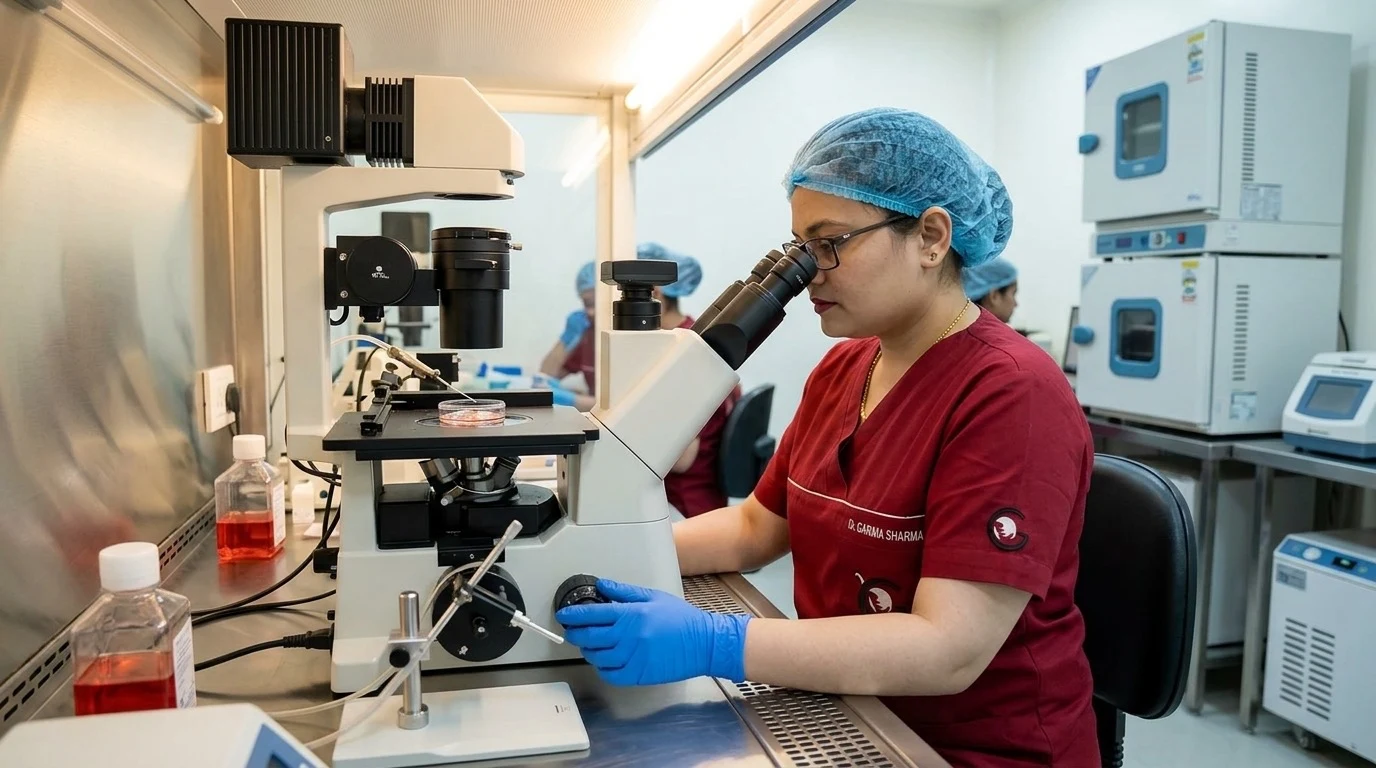
The aspirated fluid passes through a heated window directly into our Class 10,000 cleanroom laboratory. Embryologists locate the eggs, rinse them in nutrient media, and combine them with your partner's prepared sperm. We culture developing embryos in benchtop incubators calibrated to five percent physiological oxygen.
At Day 5, an embryo develops into an inner cell mass and an outer trophectoderm layer. Many Day-3 embryos stop growing on day four due to paternal genome activation errors. Growing embryos to Day 5 filters out arrested cells naturally, giving you an implantation rate near sixty percent per transfer.
Transfer day is surprisingly quiet. You don't get an injection, and you don't go to sleep. You lie on the examination table just like a routine checkup. Our doctor threads a soft, hair-thin catheter through the cervix. We turn the ultrasound monitor toward you so you and your husband can watch. You see a tiny bright spec of light, that is the fluid droplet carrying your blastocyst, gently glide into the center of the uterus. It takes five minutes without pain or stitches.
You rest on the couch for twenty minutes, empty your bladder comfortably, and walk out to your car.
Understanding Your Real Odds Without Marketing Spin
Patients often ask for a single magic percentage. While female age matters, looking at a single transfer gives an incomplete picture.
When a retrieval yields three frozen blastocysts, your cumulative pregnancy odds across successive transfers exceed seventy-five percent.
If the first embryo does not implant, you do not repeat injections or retrieval surgery. We thaw the next blastocyst and transfer it into a rested uterine lining. One failed transfer is not a failed journey. It simply means that specific embryo was not chromosomally balanced.
Common Worries We Clear Up Every Week
Older relatives often tell women to stay flat on their backs for two weeks after transfer. That is actually harmful. Clinical trials prove that complete bed rest does not improve implantation rates. Sitting on the couch for two weeks increases blood clot risks and elevates anxiety. Walk around your home. Eat fresh dal and sabzi. Return to your desk job within forty-eight hours.
Women also worry that collecting twelve eggs in one cycle brings menopause closer. That is physically impossible. Your ovaries naturally recruit dozens of follicles every month. In an unassisted cycle, your body selects one and lets the other twenty die. IVF stimulation simply rescues the follicles that were already destined to shrivel that month. It leaves your future ovarian reserve completely untouched.
Patients often fear having triplets or quads. In early IVF days, clinics transferred three or four embryos at once. Today, advanced blastocyst culture allows us to practice Elective Single Embryo Transfer. Transferring one top-grade blastocyst delivers excellent pregnancy rates while keeping mother and baby safe from twin complications.
Over ten million IVF babies have been born globally since 1978. Massive international studies following these children into adulthood show identical intelligence, physical growth, and long-term health compared to naturally conceived peers. The treatment merely helps egg and sperm meet when biology faces a roadblock. Once that bridge is crossed, nature takes its natural course.
Frequently Asked Questions About IVF Full Form & Meaning: What Is IVF and How Does It Work?
What does IVF stand for and what is its primary biological purpose?
IVF stands for In Vitro Fertilisation. "In vitro" is Latin for "in glass," referring to the laboratory process where mature eggs retrieved from the ovaries are fertilised with sperm in a specialized culture dish, creating embryos that are subsequently transferred to the uterus.
Is the IVF procedure painful?
The majority of the IVF process involves minimal physical discomfort. Daily stimulation injections use micro-fine needles similar to diabetic insulin pens. The egg retrieval procedure is performed under short intravenous sedation so you feel no pain, and embryo transfer is completely painless, requiring no anesthesia.
How long does one complete IVF cycle take from start to finish?
A single fresh IVF cycle takes approximately 3 to 4 weeks from the start of ovarian stimulation injections on cycle Day 2 or 3 to the embryo transfer. If opting for a frozen embryo transfer (FET) to maximize uterine receptivity, the transfer occurs in the subsequent menstrual cycle.
Are children conceived through IVF as healthy as naturally conceived children?
Yes. More than 10 million babies have been born worldwide via IVF since 1978. Extensive international epidemiological studies demonstrate that IVF babies have identical developmental, cognitive, and long-term physical health outcomes compared to naturally conceived peers.
What is the medical difference between IVF and a "test tube baby"?
There is no medical difference. "Test tube baby" is an informal, historical lay term coined in 1978 following the birth of Louise Brown. In modern clinical practice, embryos are cultured in sterile Petri dishes inside high-precision benchtop incubators mimicking the human fallopian tube and uterus.
The Path Forward: Taking Your Next Step with Confidence
In vitro fertilisation is not an experimental or mysterious procedure. It is an established, highly refined medical science that assists natural biology when physical or hormonal barriers stand in the way. Whether you are dealing with tubal occlusion, low sperm count, or unexplained delays, understanding each medical phase replaces anxiety with clear, actionable direction.
If you are considering your fertility options, your initial appointment should focus on accurate diagnostics rather than rushing into treatment. Bring your past medical records, menstrual cycle tracking, and any previous semen analysis reports. A baseline pelvic ultrasound on Day 2 or 3 of your period, combined with Anti-Müllerian Hormone (AMH) testing, provides an accurate foundation for an individualized protocol.
At Gunjan IVF World, Dr. Gunjan Gupta Govil and our senior reproductive team work with complete clinical transparency across our centres in Indirapuram Ghaziabad, Janakpuri West Delhi, Noida Sector 49, Greater Noida West, and Meerut. Schedule an in-depth clinical consultation to review your reports and establish the right medical treatment for your family.